“Two souls dwell, alas, in my breast’ (Faust I)
The path to finding meaning in human life stands or falls with the realization of what a human being is. What is the nature of a human being: Who am I?
As for Homo sapiens’ relationship to its own nature, the earliest evidence that goes beyond biological physicality—that is, the earliest conceptions of the afterlife—comes from Egypt and Babylon; these are documented from around 3000 years B. Then, in ancient Greece, a characterization of the material human emerged, who—as a physical being—was already conceived as possessing a divine core. At that time, people were, of course, already aware of the significance of the answer to this question. Thus, the inscription above the Temple of Delphi, where the oracle Pythia foretold the fortunes of those who sought her counsel, reads: “Know thyself” (“Gnothi se auton”). And she emphasized this with a further admonition: sophrosyne, moderation. This calls upon human beings to master the typical thoughts of fear, greed, and anger associated with material consciousness.
In this way, they can embark on the path to liberation from suffering in the here and now.
Today, we find the theme of self-knowledge in a wide variety of areas of human culture:
Literature:
“Just as in every human being, so too in Nekhlyudov there lived two people: the moral man, who sought his well-being in the well-being of others, and the animalistic man, who sought only his own well-being and was ready to sacrifice the whole world for it …”
(Leo N. Tolstoy: Resurrection; Volume I, Chapter 14)
Painting:
In his painting “The Drowned Boy,” the Norwegian artist Edvard Munch depicts a light-colored and a dark-colored male figure walking side by side, intended to represent the two sides of the same person, both struggling to dominate him. The artist himself comments on this as follows:
“The division (!) of the soul, … which, like two birds tied together, each strives toward its own side … a terrible struggle within the cage of the soul.”
(Munch Museum, Oslo 2007)
Philosophy:
Arthur Schopenhauer, when asked who he was: “Man resides in the heart, not in the head. True, we are accustomed to … regard the familiar ‘I’ as our true self. …But this is merely a function of the brain and not our truest self, … which remains intact even when the [‘I’] perishes in death.”
(The World as Will and Representation. II, 19)
Islam:
The Sufi mystic Ibn Arabi wrote in the 13th century:
“Know this: Human existence consists of the spiritual soul (ruch) … and the instinctual soul (nafs) …”
(The Wisdom of the Prophets II, Chapter Junus)
Hinduism:
The sacred text of the Hindus, the Bhagavad Gita, describes human beings as follows:
“The nature of all beings is twofold; partly divine, partly of a lower nature.” (XVI,6).
Furthermore, the Gita says the following about the higher part of the human soul, the spiritual soul (the lower part: the lower part: the animal soul of self-preservation):
“I am God, the eternal Self, who dwells within every being. … (X,20)
Christianity:
The prominent Christian theologian of the High Middle Ages, the Dominican priest Meister Eckhart, writes:
“The soul, then, has two aspects: The higher one always gazes upon God, and the lower one looks downward and directs the senses.” (Sermon 49)
“It is also clearly evident that man possesses two natures within himself, body and spirit. … There is an outer man and another, the inner man.” (On the Noble Man)
Jesus expresses this wavering between these two souls in his agony in the Garden of Gethsemane as follows (Gospel of Matthew 26):
“Not as I [ego = instinctual soul] wish, but as you [spiritual soul] wish” (39);
“The spirit is willing, but the flesh [instinctual soul, self-preservation] is weak” (41).
The evangelist John has the Nazarene speak as follows:
“I can do nothing of my own.” (5:30); “The Father in me—he does the works” (14:10).
In the 17th century, the Silesian mystic Angelus Silesius wrote:
“There are two people within me:
One wants what God wants,
the other, what the world, the devil, and death want.”
(The Cherubic Wanderer V, 120)
The vernacular:
It speaks crudely but aptly of the “inner pig” as the counterpart to the “conscience” with its typical admonitions, the pangs of conscience.
Jewish wisdom:
In the second account of creation, humanity is symbolically expressed through the two elements from which it was created: on the one hand, the material “clod of earth”; on the other, the spiritual “breath of God,” the immaterial, transcendent dimension (Genesis 2:7). This dual nature is symbolized by Cain and Abel (Gen. 4:1–16, as well as in the Quran in Sura 5, 27 ff.)
These and many other similar references first and foremost illustrate the structure of the two parts of our inner life; some, however, also point to their moral significance. Although every person is somehow aware of these opposing components of their inner life, they generally lack conscious control over their functions. Rather, most people react automatically to “seeking only their own well-being,” as suggested by examples such as cutting in line, lying, 500,000 hit-and-run accidents per year, tens of thousands of visits to brothels per day, or countless cases of tax fraud—not to mention crimes or war.
On the one hand, these two parts of the soul consist of the instinct for self-preservation—the ego program within humans, the instinctual soul—which loves itself first and foremost and, at most, its own surroundings; it resides on the material plane of existence. The other part of the soul is love for all other human beings, intuition, the inner voice, “the Father within me,” the spiritual soul, the gut feeling, the conscience. The spiritual soul, the “better soul” (Faust I, Study Room) is situated on the spiritual level of human consciousness. It is the very program of love (see Chapter 17) that relates not only to one’s own survival, but to that of all human beings. This is the God-son born within, who “seeks his own good in the good of others.”
Can anyone express it more aptly than Goethe, who has Faust say:
“Two souls dwell, alas! in my breast:
One clings to the world in coarse lust for love
with clinging limbs;
the other lifts itself forcefully from the * dust
to the realms of lofty ancestors.”
(Faust I. Before the Gate)
______________________________________
* Nothingness (derived from “dust”)
Early Christianity, based on the New Testament and through the life of Jesus, recognized these two dimensions of human life—namely, the clearly visible contrast between “body and soul” on the one hand (the physical and psychological dimensions) and “spirit” on the other .” From this, it developed the so-called doctrine of the two natures, first at the Council of Nicaea and later, specifically, at the Council of Chalcedon. This doctrine seeks to reconcile this mixture of “spirit and flesh” in some way: How, for example, can one reconcile Jesus’ violent outburst against the money changers in the temple with his absolute forgiveness toward the torturers who nailed him to the cross?
Admittedly, the Church Father Augustine repeatedly addressed the aforementioned divine core—referred to in the creation account as being “made in the image of God” (1:26 ff.) —time and again. But medieval Christianity then interpreted all attempts at this spiritual self-interpretation as presumption: It emphasized a primordial distance—with the obvious exception of Jesus—between Creator and creature (“original sin”). Its dogma was to trample exclusively on the animalistic side of human beings. It consistently suppressed—for the sake of preserving power—their image-of-God aspect from the Genesis account, as well as their characterization in Psalm 8 or in Luke’s words, “The kingdom of God is within you” (17:21)—was consistently suppressed for the sake of maintaining power. To this day, nothing has changed regarding this suppression of the spiritual aspect of the inner self within church institutions and in personal pastoral care.
Due to the church’s teaching on sinfulness throughout the centuries and, as a result, the individual’s sense of loss and distraction in the modern age, the search for self-knowledge seems to have been largely lost.
On the other hand, the “two souls, alas! Within my breast” have not faded from people’s view. Although people are leaving religious institutions in droves, they are just as actively seeking alternative guidance, as evidenced by the countless forms of new religiosity and, not least, a widespread awareness of the occurrence of such behavioral expressions as “first thought,” “guardian angel,” or “gut feeling.”
The human form of existence
First of all, Goethe’s choice of the word “breast” stands for the body, the “hardware.” This is the material vessel for the two sources in question.
These come, on the one hand, “from below,” from matter, from the “flesh,” and, on the other hand, “from above,” from the spiritual “realm.”
Spiritual Soul
(The “upper” part.
Upper divine half of the soul, my inner voice, “Father within me,” Atman, Son of God, “guardian angel,” intuition, conscience, ideas, “first thought,” “benzene ring” (Kekulé), flash of inspiration, gut feeling. Spiritual love (Agape) .
Material soul: “Flesh”
(The “lower” part.The “software” with two drives:
Sexual drive (Eros) from our animal genetic heritage. Human emphasis: Lust.
Human love in the form of sympathy, a sense of belonging (Philia).
The lever of consciousness
The place where the “two souls” meet is human consciousness, which, through free will, possesses the ability to choose and the freedom to decide between them. In this respect, a person can choose between Cain and Abel at any moment. The primary instruments for this are reason and emotion.
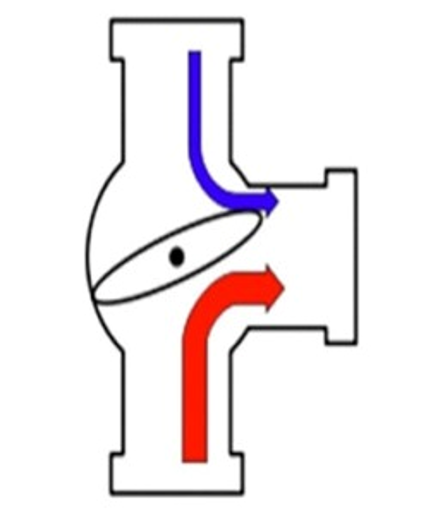
Three-Way Mixer (Biezl) https://commons.wikimedia.org/wiki
This perceiver, discriminator, decision-maker, and distributor between the two levels of the soul receives the perceptions from the sense organs as well as from gut instinct and then processes them. This is done using the aforementioned instruments of reason and emotion, and ultimately resolves the conflict between “above” and “below,”
A classic example of being torn between two choices, in which human consciousness finds itself caught between the material and divine soul, is Jesus’ inner struggle in the Garden of Gethsemane (Matt. 26:39): Out of fear for his very existence, he is assailed from the material realm below, pleading that “this cup may pass from him”—that is, torture and crucifixion; he is equally subject to the impulse from above, direct divine guidance.

Young businessman with an angel and a devil on his shoulders. altamira83 iStock 938182110
He—unlike the average person—can decide to do “whatever you want.” For he is in direct dialogue, a privilege granted to anyone who is heard and then follows what Goethe has the choir of angels proclaim (Faust II, Mountain Gorges, Blessed Host) : “Whoever (!) strives (!) with all their might (!), we can redeem!”
Fundamentally, however, most people are unaware that when making decisions, they find themselves caught between “below” and, indeed, “above.” Exceptions are rare, such as in the case of Jesus (see above) or Saint-Exupéry in *The Little Prince*: “One sees clearly only with the heart.” Puccini once perceptively remarked: “I do not compose. I merely write down what my soul tells me!”
Apart from the fact that 99% of decisions in everyday life are made for the sake of self-preservation, the potential for choosing between “below” and “above” is fundamentally not lost. This becomes clear
that in conscious, intellect-driven deliberations, self-preservation usually dominates, whereas in a fateful decision-making situation—one that’s a toss-up and in which a person, with the best will in the world, doesn’t know what to do—the decision often favors intuition.
In contrast to such unconscious … guidance is the trusting request for guidance from within, grounded in spiritual experience (almost daily):
* Pruning shrubs in the garden, high up in the bushes on a ladder. As dusk begins to fall, I head back inside. There comes the shock: my glasses are gone. Searching the spot in question yields nothing. Later that evening during meditation, a loud voice—though inaudible—says the word “flashlight.” Another search, this time at night: Under a pile of branches and leaves, a metallic glint catches the eye—the glasses.
* But: A question to the inner self: Has the time come to invite the beloved on an outing? As a precaution, he asks several times: The answer is always YES. But then she gives him a terrible rebuff. After several experiences of this kind, he suddenly realizes that questions posed to his inner guidance are always answered in the affirmative and thus lead him astray when the question is based on an intense desire and a largely neutral mindset has not been established.
Human Identities
Recognizing the division of the human soul, combined with the recognition of the Decider, is crucial for success in life. A comparison with the life of animals is illuminating in this regard:
Animals are controlled exclusively by the program of unconditional self-preservation: The life of a lion pride consists of hunting, eating, resting, sleeping, reproducing, fighting rivals, and defending their territory against intruders. Animals have only this one behavioral drive. Consequently, there is no conflict between good and evil for them, because they lack the free will to distinguish between the two. They are completely subject to the survival instinct. Accordingly, members of the pride are unable to concern themselves with other prides. And their way of life comes at the expense of others. For them, the meaning of their existence is their existence itself.
99% of humans also live almost exclusively according to this program. For them, too, the driving force in their lives is personal self-preservation, secured as thoroughly as possible. For them, too, the purpose of their existence is (unconsciously) their existence itself.
The only fundamental difference between humans and all other animals is that humans possess a second basic program in addition to the self-preservation software. It is the program for the survival of all humans, whereby individual self-preservation is reduced to meeting basic needs. In this respect, animals lack a control mechanism.
Unlike animals, humans have the ability to break free from their animalistic program of absolute self-preservation. This characteristic—and at the same time, this requirement—is the sole theme of all religions.
This requirement expresses the fact that the self-centered control mechanisms laid down by our animalistic genetic heritage at birth self-centered control mechanisms, and that the altruistic dispositions must first be painstakingly uncovered:
“Virtue needs encouragement; wickedness comes all on its own.”
(Wilhelm Busch: Plisch and Plum)
Instinctual Soul
This connection is evident in the fact that the material half of the soul instinctively resists all impulses that define humans as evolving beings. It wishes to remain in its current way of life, for it fears a threat to its purely material way of life. Accordingly, in Goethe’s human drama *Faust*, Mephisto attempts (I), to do everything in his power to dissuade Doctor Faust from his spiritual aspirations.
Of course, there are many who, while affirming further development, consistently limit it to the earthly, horizontal plane. This has not the slightest thing to do with vertical, higher development. And, of course, there are countless people who, while they “believe,” live out their formal religiosity solely through rituals and traditions, and who, after the service, continue to lie and engage in jealousy as before.
The reduction of the meaning of life to mere existence manifests itself in all sorts of forms, from “having fun” to the countless activities aimed at improving the world in a purely material sense. However, while the material standard of living has improved tremendously over the millennia, people have remained envious, self-centered, and jealous; they suffer endlessly from the evil neighbor and the mean boss, from accidents, theft, robbery, rape, and murder; on a collective level, from pandemics claiming hundreds of thousands of victims, from terrorist attacks involving knives, firearms, or trucks, and from political and religious systemic conflicts leading to civil war or war; above all, they suffer from every conceivable disease; they continue to lie and cheat and persist in using violence against children, partners, other groups, and peoples. They allow themselves to be blinded by the fascination and the promise of salvation offered by technological and social—that is, purely material—progress, and it would never even occur to them to seek a fundamental (!) liberation from their unimaginable suffering. Yet this would be the most natural thing in the world, and of course all wisdom traditions speak of nothing else. Christian churches are the exception here: they postpone deliverance from suffering into the afterlife.
Clinging to the agenda of the instinctual soul—to egocentrism—leads to a seemingly endless continuation of the cycle of good and evil, and thus also of fundamental suffering. The apparent goal of “wanting to make the world a little better” is limited to raising the material standard of living and has . The fact that this complete delusion continues to operate in people’s minds is because individual improvements are often successful, and this masks the worsening of the overall situation
(climate crisis and the threat of war). It is an illusion refuted day after day, yet one that appears more than successful and is called Maya in Hindu wisdom—the goddess of veiling (see Chapter 23 below).
The crowning achievement of the ego program is so-called love for one’s neighbor. This love, as people call it, is practiced literally in relation to their immediate surroundings—spouses, children, parents, relatives, neighbors, and friends—and indirectly also toward members of one’s own group and one’s own people (Tolstoy, see above: preferential love). It has nothing to do with the other spiritual program of caring for everyone else and is worthless for human maturity in the sense of higher development. For it is nothing other than extended self-preservation, the individual benefit of which can be seen in every pride of lions. Jesus exposes this rather bluntly: “Do you love only those who love you? There is no reward for that. Even the crooks do that.” (Matt. 5:45)
This understanding of love in relation to one’s “neighbor” excludes love for strangers or enemies, particularly due to racist prejudices stemming from an unconscious fear for egocentric self-preservation: Consider the sight of hundreds of cars driving past clearly visible—draped—accident victims on the side of the road, or countless bank customers heading to the ATM who, under the watchful eye of a surveillance camera, step over the unconscious person lying there without batting an eye.
Spirit-Soul
However, the only thing that distinguishes humans from animals is the aforementioned second program. It consists of care, devotion, and the preservation of all people: Its hallmark is, in principle, to recognize and put into practice—beyond the confines of family, friendship, and clan, as well as beyond those of the nation—the spiritual core that is at least latent within every human being.
This is at least hinted at in the parable of the Good Samaritan (Luke 10:29 ff.). Jesus makes this point much more clearly with his call to love one’s enemies (Matthew 5:44). This program is that of true love of neighbor, which recognizes all people as — spiritual (!) — neighbors.
Animals do not possess this second program. Human beings are the only beings capable of vertical development. While animals can also undergo changes in the sense of adaptation, these changes remain fundamentally on the horizontal—that is, material—level. Development to a higher, spiritual level is not possible for them.
This second program, which serves to preserve all other human beings, becomes clear—albeit to a limited extent—in the example of the Samaritan mentioned above. The stranger from Samaria—despised and humiliated by his Israelite neighbors—rushes to the aid of a complete stranger, a helpless injured man on the side of the road; he shows selfless concern for strangers. This Samaritan compassion can be found in the concept “ubuntu” found in African cultures: “I am because you are.”
True love for one’s neighbor goes far beyond the love for one’s physical and emotional neighbor described above, because it is neither individualistic nor competitive, but rather encompasses mutual interdependence and connectedness—and above all, the spirituality of all (!) human beings: The fingers of the hand are internally connected despite their outward diversity—between the thumb and index finger, etc.—but above all, they form a unity through the underlying flow of blood, which is the prerequisite for their existence. This unity is the foundation of their life, just as that of these fingers with those of the other hand and, beyond that, with the entire organism.
Although this relationship between the fingers and the equally material blood flow remains on the horizontal-material plane, it nonetheless reflects the connection between essence and form, even though the dual nature of spirit and matter—or the inner God and the outer person—exists vertically, as the unity of the external, visible dimension with the internal, invisible one.
This dual nature shows that a sustainable self-preservation for humanity can only function through the preservation of all others. But its practical realization is hindered by one’s own ego—even though there are plenty of practical counterexamples, such as Mandela, Gandhi, or the many nameless individuals who selflessly risk their lives to help strangers — even for enemies. They include lifesavers, priests, blood donors, military doctors, crisis responders, whistleblowers, and so on. They follow the second program more or less consciously, although for quite a few, their commitment is driven by a fair amount of self-preservation in the sense of self-affirmation. But the purpose behind most of their actions is higher than that of mere self-preservation.
As for a mother’s care for her child, this occurs predominantly out of an unconscious form of self-preservation in an expanded sense—see lion prides. But mothers, as well as rescuers and helpers in general, are already climbing the first rung of the ladder toward the karmic overcoming of egocentrism through their devotion. Nevertheless, in terms of consciousness, they remain within the confines of the material world; there is not yet a higher connection to the spiritual destiny of human life in general (see Chapter 10). In Christianity, this is referred to as “perfection” (Matt. 5:48); this concerns the true meaning—and purpose—of existence, as described by all wisdom teachings. Whether one chooses to believe it or not, they do have meaning. And their central message is to turn toward others “as one would toward oneself” (Matt. 19:19). This goes beyond preferential love and always involves the sacrifice of aspects of the ego (see the following chapters): “The sacrifice [of egocentrism] is the law of the Universe!” (Bhagavad Gita: III, 15).
– Judaism, Leviticus 19:18:
“You shall love your neighbor as yourself…
– Islam, Quran, Sura 41:34:
“Repel evil with what is better, and then the one with whom you are at enmity will become
a close friend and supporter.”
– Hinduism, Bhagavad Gita, Canto XIII:
“The spirit of life dwells in everyone’s heart … (verse 17)
“Whoever understands Him as the One who dwells in all does not revile his own Self in the Self of another. Such a one walks the path to the heights.” (verse 28)
– Buddhism, Dhammapada, verse 5:
“Hostility in this world is never ended by hostility. Through non-hostility
hostility ceases.”
– Daoism, Tao Te Ching, Verse 49:
“The wise person’s heart beats in all, therefore he is equally kind to the good as to the bad.”
– Christianity, Matthew 5:44:
“Love your enemies, bless those who curse you, and do good to those who hate you .”
“You shall love your neighbor as yourself.”
However, the crucial addition “as yourself” is a foreign concept to 99% of people. For treating all other people the way I treat myself is not possible at the level of purely material consciousness. Cain sends his regards. “As yourself ” presupposes a level of spiritual consciousness where the beginning of universal forgiveness and the practice of loving one’s enemies lies. This refers—though not immediately apparent—to the central factor of sacrifice. This is not primarily about giving up money, energy, or time, but above all about not striking back, not worrying, giving only in secret (Matt. 6), and about all the other demands, such as those contained in the Sermon on the Mount. It is the surrender of negative thoughts and selfish will, the overcoming of the ego’s self-centeredness, the surrender—the sacrifice—of the ego.
For some people in certain fields of work, being there for others is, on the one hand, nothing more than a job; on the other hand, however, it is a calling for many. It enables the care and devotion for others that is inherent in them. But what a degree of understanding, consideration, protection, care, and boundless forgiveness does it require to “love as yourself.” This strikes at the heart of the personal ego—currently particularly evident in the migrant issue, especially in Europe and the U.S. It involves a great degree of letting go of the ego, as demonstrated by great role models such as Gandhi, Buddha, Jesus, Martin Luther King, Mandela (forgiveness), Janusz Korczak, U.S. Army medic Desmond Doss, Mother Teresa, or Malala—but also by many “ordinary” fellow citizens who time and again consciously (!) paid for their devotion with their lives, such as Franz Jägerstätter (executed in 1943 for conscientious objection) or bank employee Arland Dean Williams Jr. ( “Potomac Mystery Hero Identified”).
The level of Universal Love (see Chapter 17) refers to an understanding of the spiritual unity of all human beings: It has nothing to do with earthly emotions such as affection. It is “merely” about recognizing the spiritual substance inherent in one’s own (!) self and, indeed, in all other human beings as well. It is about the aforementioned recognition of the “eternal Self (see above), which is inherent in every being,” which recognizes “its self in the other’s self”.
When Jesus uses the term “love of one’s enemies,” this has nothing to do with the meaning of the word “love” as people use it in interpersonal relationships on the material level, with sympathy and emotion. Rather, it is exclusively about the understanding of the spiritual unity of all human beings, similar to that of the fingers on the hands. For the basis of the unity of the fingers is the shared bloodstream, without which these fingers—and indeed the entire human being—would not exist. Applied to the spiritual level, it is the insight into the shared divine nature image in every human being:
“You are gods!” (John 10:34)
“God shows no partiality!” (Acts 10:34)
“Cease from man with his breath in his nostrils!” (Isa. 2:22)
“I can do nothing on my own; the Father in me does the works!” (John 5:19)
“There is no partiality with God!” (Acts 10:34)
“You are gods, and all of you are children of the Most High!” (Ps. 82:6)
“The One who is in you is greater than the one who is in the world!” (1 John 4:4)
“You will do even greater things than I have done!” (John 14:12)
The understanding of shared likeness to God is the foundation and perspective for Jesus’ “love for one’s enemies.” This level of “love” does not refer to the material part of the soul (the instinctual soul of self-preservation), but only to the spiritual part (see below). It is the realization that even the most brutal person is a son of God, even if his access to this divine nature is completely blocked. (Of course, any just punishment for a misdeed on the worldly level remains in effect.)
The higher level of love encompasses the awareness of one’s own spiritual soul’s likeness to God (Gen. 1:27) above the material dimension of the instinctual soul. It is the conscious realization of the unity of one’s own divine nature with that of one’s counterpart. It is the decisive stepping stone toward attaining the awareness of the unity of all being.
In Christianity, this level of “love” is essentially exemplified by Jesus’ way of life; in Buddhism, for example, by Siddhartha Gautama; but also much more concretely, for instance, by Mahatma Gandhi. However, it is foreign to the vast majority of people. The reason for this is the associated unconscious fear of endangering one’s own self-preservation. After all, it would mean practically standing up for complete strangers, just as one would wish for oneself—that is, for one’s own preservation—if one were in their place (Golden Rule: “Do unto others as you would have them do unto you.” Matt. 7:12).
All these passages, however, are initially merely quotations, more or less insightful. Ultimately, what matters is their effectiveness in everyday life. Anyone who begins to engage with and interact with the people around them—and beyond—with this level of awareness will experience miracle after miracle: Their previous world of good and evil is increasingly transformed into a world of only good—that is, without evil. Although it remains the familiar material environment and also involves setbacks, but it always ends harmoniously and successfully.
However, with regard to the aforementioned interaction with complete strangers—and in light of the ever-present issue of migration in modern times—this does not mean opening the floodgates to uncontrolled immigration. On the contrary: Because an uncontrolled influx of mass immigration—especially into areas that are existentially attractive—quickly leads to the collapse of the entire community due to overpopulation, caring for destitute strangers “as for oneself” can only consist of making a collective effort to ensure dignified living conditions for the local residents in their current places of residence—precisely as one would wish for oneself as a local resident affected by the situation. But people today (“first,” “Deutschland, Deutschland über alles”) are far removed from such a self-evident sense of solidarity in the spirit of global humanity.
We come into the world with self-preservation, the unconditional instinct for survival—naturally: It is a necessary basic program that enables us to overcome crises, find solutions, protect our children as they grow up, and so on. But among the aforementioned 99%, this basic program develops into egocentrism, which unconsciously remains trapped within the described framework of animalistic, self-serving “love of one’s neighbor.” A sense of humanity that extends beyond the confines of one’s self-centered environment is unconsciously blocked in people by the program of self-preservation. With their egocentric behavior, these individuals are are “merely” obedient executors of the impulses of their instinctual soul. These impulses lead humans to “more animal than any animal” (Goethe: Faust I, Auerbach’s Cellar): Animals do not build concentration camps.
The fact that people live in ignorance of their two inner control mechanisms—and also of the fact that they have the potential to flip the switch—is the reason for the enlightenment efforts of the Bible, the Gita, the Quran, the Dhammapada, the Tao Te Ching, and so on. The Sermon on the Mount, for example, constantly calls on people to make this 180° course correction—toward “love” for one’s enemies and all-encompassing forgiveness.
Although people generally lack awareness of true love for one’s neighbor in the sense of the Golden Rule, they nevertheless find themselves—as a result of the unconsciously nagging mental program (conscience)—in an equally unconscious conflict between love of the self and love of others.
In literature, Robert Louis Stevenson attempted to explore the split in the human soul in his novella “Dr. Jek yll and Mr. Hyde,” even though he views it only on the material, horizontal plane, without the spiritual vertical.
As for the dominance of egocentrism in humans—in contrast to intuition, to the inner voice—people have, throughout the millennia, always sought to depict this animalistic force artistically, such as in the prehistoric lion-man of Hohlenstein, the ancient Greek Minotaur, or the centaurs.
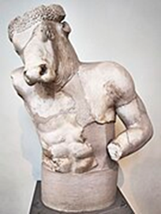
Statue of the Minotaur (Roman copy after an original by Myron) National Archaeological Museum of Athens. Commons.wikimedia.org:
_at_the_National_Archaeological_Museum_of_Athens_on_3_April_2018.jpg)
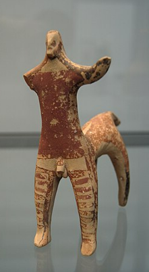
Centaur (terracotta, State Collections of Antiquities, Munich, 8th century B.C.
Genitals here on the front legs, not the hind legs!
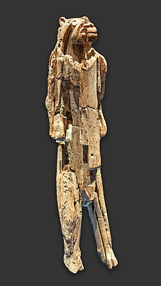
Lion-Man of Hohlenstein. Thilo Parg. Wikimedia Commons. License: CC BY-SA4. 0
But it was not until the great wisdom texts of about 500 years before our era that the divine aspect of humanity began to be brought into consciousness. (Even in a rudimentary form, this was already present over 1,000 years earlier in Gilgamesh or Zarathustra.)
Becoming aware of one’s divided soul means gradually reducing one’s material aspect—that of the mammal—and . Buddhist wisdom calls this “recognizing both worlds” (Dhammapada XIX, 269). Paul calls this “dying daily.” By this he does not mean a biological wasting away of the body—the “hardware”—but rather, through this reduction of the ego, unfolding the spiritual soul—the software of the Son of God. In practice, this is usually initiated through meditation, which trains one to suppress the egoistic—and therefore always fear- and vengeance-filled—whispers. Through this, receptivity to the inner voice, intuition, and gut feeling is increased. Consequently, in practical everyday life, this leads more and more to the overcoming of ego-driven behavior through service and a willingness to sacrifice for others, with the focus on strangers. Self-sacrifice for one’s own partner or children is the realm of the animal world and is something anyone can do. Although it has considerable significance in terms of solidarity on the earthly plane, it is, as mentioned, worthless for the death of the ego.

Oleksandr Chaban: In a human being there is good and evil … Who are you, human? iStock 94401140
In the world of ancient Greek mythology, the activated spiritual soul of a human being is referred to as a “demigod,” as in the case of Heracles. Very few people realize that this term essentially refers to every human being, even though this spiritual potential is often enough walled off—and in many cases, completely so. The term “demigod,” however, refers above all to those who actually confront their inner conflicts (attacks of egoism, envy, greed, hatred, etc.) and, with a growing awareness of the power of their spiritual aura, successfully take up the fight against their animalistic software.
Everyone has the potential of a demigod or child of God because they possess the divine spark, whether they are aware of it or not. Everyone has the spiritual potential for self-knowledge and self-liberation: “You are gods and all children of the Most High.” (see above). It follows that spiritual development, transformation, enlightenment—or whatever one wishes to call the attainment of a higher consciousness—is the very essence of the human being; no special gift is required for this.

Figure emerges from the cosmos. Bestdesigs. iStock 1099434540
But few have attempted to make it clear to us that each of us, at our very core, is unique, divine, and fascinating: “What good is it if I were a king and did not know it?” (Meister Eckhart: Sermons 15)
The churches have focused, especially since the beginning of the Middle Ages, on harping exclusively on the sinfulness of human beings. Jesus’ teaching—to show people paths to their own perfection (“You will do even greater things than I have done!”) (see above) and to exemplify this himself—was, to them, nothing less than presumption, arrogance, and haughtiness. Their understanding of humanity was that of a creature—a purely earthly being with an “inherent distance” from the Creator God. Through this constant devaluation, they sought to suggest their own superiority and thereby expand their position of power. That is why they also wisely hushed up any enlightenment—such as that brought by Meister Eckhart—and, if necessary, suppressed it by force—using the combative term “heretic.” And that is also why they persecuted the Cathars, Johannes Tauler (“The Godlikeness of Our Spirit”) and Joan of Arc, persecuting them and, whenever possible, killing them.
The reason for our divine origin is stated in the story of creation: It is the aforementioned likeness—that is, a relationship like that between a father or mother and a child. Although it is not equal to that of adults, it is already on the same level. Unlike other mammals, this is associated with creative potential. But this likeness is not enough for the human ego. It wants to play God (Gen. 3:5) and achieve divine equality: “… above everything in the world.”
Of course, humans possess creative power, but only in terms of developments, not principles. These principles existed even before humans, just as relativity existed before Einstein. Through genetic manipulation and cloning, humans can create the design of life, but not life itself. Dr. Viktor Frankenstein sends his regards.
That human beings possess a divine core seems, at first glance, hardly credible in light of their predatory behavior and what they do to our planet and their fellow human beings. Modern humans in the age of globalization face a myriad of threats from “others”—such as competitive pressure, terrorist attacks, job insecurity, refugee flows, burglaries, drug use, and religiously motivated violence, among others—in which it is difficult to discern the aforementioned divine heritage.
And yet it is also part of everyday life to witness incredible talents, remarkable achievements, and acts of self-sacrifice for the common good. The great role models of human history are not to be understood as exceptions , but as role models, as examples of the inner potential within every human being—much like parents are for their children. Every day we witness the incredible abilities, talents, and courage that lie within people—such as lifesavers, healers, scientific minds, gifted leaders like Mandela or Gandhi, social angels, and so on.
Humans are the only living beings capable of vertical transformation. A rose cannot do this any more than a lion can. And, as mentioned, animals cannot break free from their animalistic self-preservation instinct. Only humans can evolve spiritually to a higher level. Goethe, a master of poetic synthesis, sums it up:
“Were the eye not sun-like,
it could never behold the sun;
were God’s own power not within us,
how could the divine delight us?”
(Tame Xenies, Book 3)
The two forces governing human behavior, between which consciousness must choose: Two souls dwell, alas, in my breast!
An awareness of the spiritual second identity—that is, beyond the egoistic instinct for self-preservation and emotional love—this awareness of the soul’s power of spiritual love (see Chapter 7) is indeed present in most people, but it is blocked. Their self-awareness amounts to perhaps 1% of their entire way of being. For a level of spiritually guided life (“Thy will be done!”) would indeed be recognizable by freedom from all suffering, all worry, and all fear (Job, Chapter 42).
Materialistically oriented people believe that they consist only of the mind, emotions, memory, and, of course, the body. They are convinced that the mind is their primary controlling force. But the fact that it is merely a tool and is itself guided by inputs from “above” (the Spirit) and—almost always—from “below” (the ego)—is out of the question for them.
Of course, there are also many who “believe” in the existence of a guiding soul within them, but without any consequences: For after they leave the church service, they continue to be envious, stingy, and lie just as before. And the churches remain silent about this contradiction; for then their lack of success throughout the millennia would become apparent. To cover this up as best they can, their doctrine shifts salvation to the realm beyond death: “post mortem.” Of course, people notice this and are therefore leaving them in droves. Incidentally, other religions emphasize the opposite of “post mortem”: “he has attained perfection here”; see not only Job (see above) or the Bhagavad Gita in XVIII, 46. What is decisive, however, is the concrete experience of the many people who have walked the path of ego-crucifixion.
(In this regard, it is always a promising practical aid to imagine one’s own likeness before every undertaking, decision, or step—to visualize it, for example, as a surrounding aura. For more details, see Chapter 16 on meditation).
These individuals are thus on the path to personal fulfillment, which is clearly evident in the sacrifice of the ego on the one hand and, on the other hand—as a consequence —freedom from suffering. In some cases, the personal sacrifice of self-preservation even extends to the surrender of one’s life, as with Janusz Korczak, Arland Williams, and also some soldiers on the front lines.
Ignorance of one’s own higher identity is the cause of all suffering in this world, a fact that Hindu wisdom clearly recognized two and a half thousand years ago. We are biological mammals (“sons of man”), but at the same time, as far as our spiritual aspect is concerned, demigods—that is, sons of God. We are an expression of the mammal’s instinctual life, but also an expression of the divine power of love that recognizes the hand within the glove. Accordingly, Jesus emphasizes: “You are all gods!” (John 10:34). The fact that we live in a vale of tears is a consequence of our lack of knowledge about this.
What would have happened if human beings had been aware of their divine heritage, their divine identity (alongside their animal nature), from the very beginning of their earthly existence? The enlighteners were there: Odysseus, Heracles, Jesus, many prophets, martyrs, Plotinus, Ibn Arabi, Nanak, Buddha,
Lao Tzu, Maimonides, Meister Eckhart, Goethe (Faust), Gandhi, Mandela, Mother Teresa, Eckhart Tolle, and many others. Yet people have never viewed these guides as examples of their own hidden potential, but rather as exceptions from some other world, whom one can only regard with awe and adoration. That is why the Hindu monk Vivekananda urges every person:
“Do you know how much power, strength, and greatness lie hidden within you? Human beings have revealed only an infinitely small part of their true power. Anyone who thinks of them as small and weak is mistaken. Do you know everything that lies within you? Within you are unlimited strength and bliss. Within you lives the Spirit of the World, whose inner voice is the only one to which you should listen. Recognize who you truly are: the soul that is not subject to death, the all-knowing soul. Remember this truth day and night until it has become an integral part of your life and guides your thoughts and actions. Remember that you … are not the sleeping, everyday person. Awaken and rise … and reveal your divine nature.”
Such a call has never been made from a Christian pulpit—nor can it ever be. For it would immediately cause the house of cards that is the doctrine of Jesus as the sole Son of God to collapse—along with the unconscious demotion it implies of the other great prophets such as Moses, Buddha, Muhammad, Zarathustra, Krishna, Nanak, or Lao Tzu.
However, as long as each individual lacks self-knowledge regarding their own divine image, base animalistic behavior—driven by self-preservation—dominates. This is precisely why the egocentric human being can fall ill, experience desires and fears, lie, cheat, torment, and kill.
Christology
The Nazarene’s statement “I (?) am the way, the truth, and the life” (John 14:6) certainly cannot refer to the half that knows of itself: “I (?) can do nothing on my own” (John 5:30):
For: “it is the Father in me who does the works” (John 14:10). The material “I,” which can do “nothing on my own,” could not be the part of the Nazarene who embodies and brings about truth and life. Due to the ambiguity surrounding the divine aspect of our identity, the word “I” was mostly applied to the material side of the Nazarene, to his person, even though he himself testifies in various passages that he is not to be regarded as this person, as the outer man, as a glove, as the “little I”:
“If I (!) testify on my own behalf, my testimony is not true.”
“God does not look at the person.”
“A person looks at what is before their eyes, but the Lord looks at the heart.”
“Why do you call me good? No one is good except God alone.”
Furthermore, when speaking of himself as a person, he uses exclusively the term “Son of Man.”
That “I” as the Way and the Truth could therefore not be the material “I” of the carpenter and rabbi, and thus certainly not the little “I,” the self-preserving half of the person in the form of the instinctual soul. It had to be the divine soul within him, the other part, the immaterial, the mighty, exalted I from Exodus 3, in which God names Himself. (“I AM who I AM”), the Christ within man. (It is that instance, that inner voice, which the Quakers call the “Inner Light.”) The Nazarene thus refers his statements sometimes to the material part of his soul, and at other times to its divine part; in doing so, he does not specify—with the exceptions noted above—whether he means the “lower” part of his soul or the “higher” part.
He continues: “You will know the truth, and the truth will set you free.” He does not say, for example, “I” will set you free! Jesus also never said that he is God, but he emphasizes that he has God within him.
From the very beginning, the churches have interpreted this saying in such a way that Jesus is presented as the only human being who embodies this path and this truth. This is contradicted not only by a number of his own statements:
“The Kingdom of God is within you.”
“The one who is in you is greater than the one who is in the world.”
Indeed, Jesus was the great beacon of Christianity, but by no means the only one of universal significance. His teaching on human self-knowledge regarding the divine aspect—along with forgiveness and love for one’s enemies—can also be readily found in the ancient Hindu texts of the Vedas, particularly in the Bhagavad Gita through Lord Krishna: “I dwell in everyone’s heart.” (XV,15) In the same vein, the Islamic mystic Ibn Arabi comments on a saying of Muhammad: “Whoever knows himself knows his Lord.” The following is attributed to Siddha Yoga: “Look within; you are the Buddha.” The same ideas can be found in the ancient Chinese Tao Te Ching (Daodejing): “Whoever, seeking clarity, looks within, attains … truth.” (10)
Because the “breath of God” has been breathed into human beings (Gen. 2:7), it is true for everyone that the “I” within them is “the Way, the Truth, and the Life,” regardless of how strongly this inner light is either unfolding or, conversely, blocked. This polarity of the human being—on the one hand, the animal nature, and on the other, the spiritual human being—is expressed by Jesus, as mentioned, when he says of himself: “Of my own accord [material person] I can do nothing,” “the Father in me [spiritual intuition] does the works.” (John 5:30; 14:10).
The concept of the soul has given rise to countless interpretations and the corresponding confusion (see Wikipedia). Goethe’s choice of words regarding the two souls in the breast brings simplicity and clarity, but insight can ultimately only come through confirmation in practical life; and anyone who “strives ceaselessly” (Faust II: Mountain Gorges), can discern these differences for themselves when they learn to distinguish between fantasies of fear, retribution, and anger on the one hand, and first thoughts, ideas (!), and gut feelings—seen with the “heart”—on the other, especially through the results of practical living.
Unlike that of the lion, human consciousness is the life-determining arbiter between spirit and matter, with a dual perspective between intuition and logic, between divine and animal heritage, between idea (Plato) and reason, between the “inner man” (Paul, Ephesians 3:16) and the outer person (“Son of Man”). Intuition corresponds to the sun’s ray, which provides humans with light (knowledge) and warmth (love). The mediator—human consciousness, with its instruments of reason and emotion for processing spiritual impulses—decides which inspirations to follow, whereby “decisions” also include unconscious behavior.
Through his inner, intuitive way of life—the “Father within me,”—Jesus always sought to divert attention from himself: “Why do you call me good? No one is good except God!” (Matt. 19:17) In this way, he expresses the distinction between the two aspects within the human being; as a person, he addresses his inner God with his material consciousness (Matt. 26:39 ff.). The existence of this inner God was already expressed in the Bhagavad Gita five hundred years before the Gospel.
The churches avoid teaching the direct, individual access of each person to their divine soul—the path of all spiritual seekers. The churches also suppress other statements from the Gospels, labeling them “mistranslated” or attempting to reinterpret them:
“I live, yet not I, but Christ lives in me.”
“Your body is a temple of the Holy Spirit who is in you.”
The reason is obvious: If they were to acknowledge that this perfect Self resides in every human being, they would lose their monopoly on being the authorized intermediaries for access to God and, in one fell swoop, lose the bulk of their social power. That is why, for them, Jesus must be the only Son of God (sole; quantitatively). What is troublesome for them, of course, is: “You are all gods.” (John 10:34). Their interpretation—which, as with Buddha, Krishna, Muhammad, Moses, or Lao Tzu, makes him the “One” based on his uniqueness (exceptional; qualitative)—distracts from the fact that every human being is unique, but that an outstanding special case is not, for that reason, one-of-a-kind. In this way, they successfully divert attention from the divine potential within every human being, no matter how deeply buried it may be—even in, for example, a murderer completely devoid of empathy. The interpretation of the “One” in contrast to the great prophets of all other religions is intended to divert attention both from spiritual enlightenment through other wisdom teachings and from situational guidance through one’s own intuition. But what really matters,
Johanna demonstrates; she makes it clear that the path to spiritual enlightenment is individual and, as in her case, works without the church or the priesthood:
“I do believe that the militant Church cannot err or fail. But I entrust my words and deeds solely to God, who commanded me to do what I have done.” (In: DIE ZEIT, No. 2, Jan. 5, 2012).
The churches direct attention outward toward the person, not only away from being guided by one’s own inner voice, but also away from the statement: “The one who is in you is greater than the one who is in the world!” (1 John 4:4), as Paul perceptively notes. That is why it is so important for them to ignore such admonitions from Jesus on the subject of “Know thyself”—such as, for example, “You are all gods!” (Ps. 82:6; Isa. 41:23; John 10:34) “and will do even greater things than I” (John 14:12).
That is why Christian organizations in the past immediately executed anyone who claimed to possess a kind of divine spark—the “inner light”—that is, someone who, beyond their earthly identity, had also recognized their spiritual identity, such as Al-Hallaj, Joan of Arc, or, in a somewhat similar vein, the Cathars, and of course Jesus. In this respect, it is important for them to avoid associating “inner light” ” and “seeing clearly only with the heart” from that of the “even greater works” for all other people.
Consequently, the churches are less inclined to emphasize certain personal characteristics from Jesus’ life:
– his outburst in the temple when he overturned the money-changers’ tables,
– his inner turmoil between “above” and “below” in the Garden of Gethsemane,
– his doubts, which seemingly persisted even on the cross: “Why have you forsaken me?”
Rather, their focus is always on emphasizing his—and, moreover, his unique—status as the Son of God, even though Jesus himself avoided this whenever possible (“Why do you call me good? No one is good except God alone!” Matt. 19:17). Thus, here as in other passages, Jesus repeatedly seizes the opportunity to point either to his inner divine guidance or, on the other hand, to himself as a physical person—just like any other human being: “I do not speak on my own. The Father who dwells in me—he does the works.” (John 14:10) as well as “even greater works than these will they do” (John 14:10)
The anger of Scottish Presbyterians toward the Quakers is evident in the following outburst:
“Cursed be all who say that everyone has a light sufficient to lead them to Christ” (Paul Held: The Quaker George Fox, Chapter 10)
To this day, it has been very easy for the churches to maintain this particular form of personality cult as a means of power, because the realization of one’s own likeness to God is not so easily attained. And when Meister Eckhart stated regarding Jesus (Wikipedia) that his
“…human nature… is no different from that of any other human being, … though an unsurpassed model, it is not, by its very nature, fundamentally different from that of other human beings. In principle, everyone is capable of realizing and accomplishing what Christ realized and accomplished”,
he was subjected to a papal excommunication. Today, the churches no longer possess the power to excommunicate; at most, they can revoke the authority to teach within the church, but any teaching that “everyone possesses an inner light for spiritual self-knowledge” would still be poison to them. This is all the more true because this personal, spiritual self-knowledge is the decisive gateway to the spiritual understanding of all other human beings (Matt. 5:43).
No other religion has come up with the idea of declaring its great prophets—such as Buddha, Muhammad, Moses, Laozi, or Krishna as the only ones in the world, thereby devaluing the other religions:
It must be emphasized that it is not the church figures themselves who are the agents, but rather the ego program of the self-preserving soul within them—a program no less effective than in all other human beings—which Hindu wisdom calls Maya, the goddess of illusion.
Although Jesus emphasized all the attributes of being created in God’s image (Gen. 1:27)—that is, the divine sonship of all people—the churches want a God somewhere up there to solve our problems; literature, sermons, and the internet are full of these views:
– “Lord, hurry to help me!”
– “Jesus—the problem-solver.”
– “Jesus Christ—the solution to the problems of our lives.”
– “Jesus is more than just a solution to problems.”
However, the wisdom of all religions—and above all, our own experiences in everyday life—show that the solutions to all illnesses and all other everyday problems lie within “ourselves”; by this we mean our inner spiritual identity, the Son of God, the inner voice, and our gut feeling—not, first and foremost, the nearest doctor or lawyer: “I, the Lord, am your healer,” (Ex. 15:26) They teach that we should “look within” and consciously use our ability to open the floodgates in order to unleash, through our spiritually enlightened consciousness, our individual spiritual guidance regarding the solution to material problems. They point out the paths to a solution and prove themselves through their practical successes.
Everyone is familiar with these two inner voices: the higher one—manifesting as gut feeling, an idea, intuition, a flash of insight, etc.—and the negative, corrosive one—manifesting as fear, an inferiority complex, arrogance, despondency, etc.—which then express themselves as negative emotions. Most people, however, are unaware of the possibility of to consistently shut off the barrage of negativity and its intrusion into our consciousness. Furthermore, there is general confusion about the purpose of this barrage from Mephisto in human life (see Chapter 13) and the fact that it exerts a decisive influence on the course of our lives. That is why George Bernard Shaw’s aphorism is so spot-on: “Man is the only creature that has a low opinion of himself.” (For an explanation of how this fatal self-assessment is, in fact, the crucial tool for overcoming it, see the aforementioned Chapter 13.)
This applies first and foremost to the destructive effect of behavioral patterns from “below,” which manifest as mistrust, hatred, arrogance, an inferiority complex, anger, and so on. But it also concerns the possibilities—initially difficult to put into practice—of following the impulses that come from “above,” that is, through dialogue with the inner spiritual (!) voice. True self-knowledge of the divine nature within the individual breaks through when we know what to do and when we (are able to) follow the guidance that reads: “Thy will be done!” (It speaks volumes that the usual emphasis in worship is on “Thy will be done!”, for this happens—at least ultimately—anyway. Above all, placing the emphasis on Thy would be a catastrophe for the human ego.
The prerequisite for the fundamental solution to all our problems is that we increasingly acquire the ability to recognize our will—which, as Tolstoy noted above, “seeks only its own well-being”—as such, and to set it aside in favor of the will of the inner spiritual voice. When we then increasingly find “our own well-being in the well-being of others,” our crises in living together—whether in marriage or family life, with unaffordable housing, or even crises such as job loss or abortion—will also dissolve. Then the spiritual forces will unfold their effect, as such examples from everyday spiritual practice demonstrate. (How a spiritual way of life guides us through existential crises (“as if by a miracle”) , see the relevant chapters.)
I and the Self
In the Christian New Testament, the spiritual core of the human being is expressed in the temptations in the desert (e.g., Matt. 4:9). There, the tempter seeks to extinguish all spiritual awareness of one’s inner sonship of God by tempting one to worship only him—that is, matter—
the life of the good-and-evil world with all its possible material splendors. It is precisely this temptation that people are succumbing to more than ever. A current term for this is “secularization.” A major reason for this, of course, is that the churches have failed to demonstrate their practicality and effectiveness, both in overcoming evil and in liberating people from suffering (see Chapter 13)
But those who have mastered the sacrifice of crucifying the ego usually lead a new life in safety, a loving environment, and material prosperity—in the eye of the hurricane, so to speak. They have left the realm of the good-and-evil world behind. We see this already in the case of Job (verse 42), but above all in the published life stories of such beacons as Mandela, Gandhi, N. D. Walsch, or Eckhart Tolle. The principle is that, through the ascent into the spiritual dimension—through the return of the Prodigal Son (Luke 15:11 ff.)—one can live out the remainder of one’s life without material good and without material evil, on the spiritual level of “only good” within the material environment.
The Tempter (Maya, the instinct for self-preservation, the devil in the desert, Mephisto), on the other hand, wants to reduce human beings to their physical form, their shell. He wants to direct them exclusively toward the small “I” and distract them from the breathed-in (or inborn) Son of God—from the Higher I. Indeed, his sole task is to ensure that people do not even entertain the idea of recognizing the principle of the Spirit behind the surface of the material world—the principle of divine life in all human beings, that of the hand within the glove.
“It is not you who lives there,
for the creature is dead.
The life that within you
makes you live,
is God.”
(Angelus Silesius: The Cherubic Wanderer II, 207)
Instinctual Soul and Spiritual Soul
Of the two souls that dwell “alas, within my breast,” one is the animalistic instinctual soul (psyche), which manifests itself in the instinct of self-preservation. It directs my life toward eating, drinking, reproducing, fighting for my livelihood, defending my territory, driving away competitors, raise offspring, and rest. Our house cat possesses all these traits as well.
Only our higher level of consciousness—and the associated ability to reach the spiritual dimension—distinguishes our mammalian nature from hers. The other soul, the spiritual soul, seeks to nourish, protect, guide, and foster our vertical development. When we consciously recognize it, there is no (!) material lack, and we receive comprehensive protection. For those who have experienced this—such as falling off a ladder, being saved during a misjudged passing maneuver, etc.—these initially frequent events are no longer coincidences.
After my workout, I drive home in the deep darkness of night amid pouring rain. On a downhill stretch of road comes the sharp left curve that I know well. I turn the steering wheel sharply to the left
, but because the road is wet from the rain, the rear of the car skids out to the right. I jerk the wheel back to the right, causing the car to skid out to the rear left. It then hits a young birch tree head-on, shears it off at the base, spins around its longitudinal axis in the air, flying over the deep ditch on the right side of the road and landing softly in the freshly plowed field—four meters from the roadside, perpendicular to the direction of travel, on all four wheels. I’m completely unharmed. After a few moments of trying to process what had just happened, I get out, fetch my gym bag from the trunk in the pelting rain, sinking up to my ankles in the soft clods of soil as I do so, stomp toward the road, lower myself into the ditch, and laboriously crawl on all fours up the ditch wall to the roadside. At that moment, I see headlights approaching me. The car stops; it’s a police patrol car. The officers pick me up, ask me what happened, and drive me home.
Through the realization of our spiritual soul, we become an inexhaustible stream of abundance for ourselves and our surroundings. The proof of this is the concrete experience that anyone can have who opens themselves to it, who “knocks” and (!) receives an answer. The effect of the spiritual soul unfolds only where it is recognized as a presence and, at some point, physically (!) perceived. Once I have consciously entered into this dialogue of questions and answers, I experience abundance and fulfillment. Then I no longer live by my own power, but am essentially lived by my higher soul—which is a terrifying prospect for the ego within a person; moreover, the common view “Finally being able to do what I want” is, in any case, unconscious self-deception, because it is the illusion of self-determined behavior on the part of the person, even though it is nothing other than external control by the instinct for self-preservation.
The dialogue with our highest self cannot, however, be established at will, and certainly cannot be earned. What we can do, however, is to build up our readiness to receive through meditation—that is, to turn our gaze away from the outside world and direct the flow of consciousness inward. The spiritual soul is constantly knocking softly to make itself heard, but most people are so caught up in the worldly dimension that they do not seek it at all, nor do they hear it —with the exception of the “gut feeling” some people experience—and certainly do not listen to it. As a result, they live in a world of lack, chance, unpredictability, and fear.
“Stop, where are you running to?
Heaven is within you;
if you seek God elsewhere,
you will miss Him forever.”
(Cherubic Wanderer I, 82)
The belief that we are separated from our spiritual power—or the ignorance that this inner voice even exists—is the cause of every single one of our problems, of every lack.
Whoever does not know that, in essence, they are above all of a divine nature, is subject to the suffering and deprivation of this vale of tears, even though it would take only one step—albeit a great one—to achieve complete self-knowledge. Every moment of worry is a demonstration of distrust toward my inner voice. Even when we look “up”—as many soccer players do before they cross themselves and then step onto the field —we have created separation in that very moment.
The solution is to look inward and become aware of the presence of our spiritual identity. Then we take a giant step toward unity, or at least union, just as the ink does with a piece of chalk. Admittedly, the example is imperfect, since ink, too, belongs to the material realm and not to the spiritual dimension, it clearly shows how much the activated divine influence transforms the animal aspect. Then the awareness Jesus speaks of grows: “You are all gods and children of the Most High.” Then our lives change, as long as we approach all aspects of daily life with this awareness.
Nothing must come to us; everything must come from us so that freedom from suffering and abundance may flow. Then (Isa. 45) all obstacles will be leveled. This is the tangible, practical experience of all people who are cared for and protected in their daily lives because they are guided day by day through dialogue with their inner voice—because they allow themselves to be guided. When we ask our soul’s power for guidance, it cares for us, protects us, guides us, and elevates us. To do this, we enter into silence, into meditative contemplation, so that the fear, anger, and hatred of the little “I” may subside, and our Higher Self may become conscious, audible, and effective.
The search for my spiritual soul is the path to true self-knowledge and self-realization, and at the same time to individual happiness in the here and now. Those who recognize this have life and full contentment. Then we are no longer responsible for our livelihood, just as the children of a loving father are not. That is his task. This does not mean that it is no longer necessary for us to work, but rather that we no longer have to struggle for it and, above all, that we can rely on it. This is the meaning of the biblical instruction: “Do not worry!” We simply “only” take care of the things that come our way, even if this requires considerable, sometimes immense effort. We no longer have to toil for our income in the “sweat of our brow,” but rather we inherit. We are then no longer dependent on earthly circumstances, but truly free. This freedom means liberation from causality and development toward perfection. This is why Jesus emphasizes as the goal of creation:
“You shall be perfect” (Matt. 5:48).
The concept of perfection fundamentally denotes a state that (see Plato) cannot change or improve any further. Since there is nothing on the material plane that is not capable of further development —not even a granite rock—a state of perfection is necessarily timeless, which is described in several wisdom texts with the adjective “eternal.” This refers to the spiritual plane. It is precisely this development that is that of the Prodigal Son, the structure of which can be found in many religions, myths, fairy tales, legends, novels, etc.
It consists of the three-step process of the entire life, that of the “Prodigal Son”:
1) Birth into matter with a lack of spiritual consciousness, but while carrying the “inheritance,” the spiritual soul (!). Then a fall into suffering marked by poverty, illness, separation, isolation, and utter earthly lostness.
2) Then the phase in the “belly of the whale” (Jonah), which may coincide with the beginning of spiritual dialogue. It is the “dark night of the soul” (John of the Cross), the deepest depression, absolute hopelessness, and at the same time the turning point—the letting go (actively) of one’s previous earthly dependencies. Above all, however, this involves the experience of the erasure of all expectations, fears, desires for retribution, plans, worries, wishes, anxieties, and other earthly contents of consciousness—all of this in favor of extensive liberation from them and complete serenity regarding security, protection, and provision through spiritual security:
“Whoever loses his life [ego] for my sake will find it! ” (Matt. 16:25)
3) Return and further ascent into spiritual consciousness, facilitated by freedom from fear, security, protection, provision, and all-encompassing love and harmony in life.
This sequence is found in the story of Jonah, who is thrown into the sea, swallowed by the whale, “cried out to God” from within its belly, and is then rescued after three days. His ascent into spiritual consciousness is demonstrated by the fact that he begins to preach.
Something similar applies to Little Red Riding Hood, who “strays from the path,” is then swallowed by the wolf, but is ultimately freed and saved unharmed.
Likewise, in the case of Jesus, we see that his earthly torments at the material ego stage lead him into the tomb, and then lead to his departure from the Valley of Tears and thus to liberation from the good/evil stage.
Job suffers the same fate; his material sufferings reveal the futility of formal faith (“I had heard of you … heard”), who then humbles himself—that is, overcomes his ego (Chapter 42)—thus finding direct spiritual dialogue (“the Lord answered”) and then experiences his enlightenment (“now my eye has seen you”)
, whereupon he is delivered from his pain. Thus he completes his resurrection on a spiritual foundation and reaps its rich fruits; in his case, however, terrible suffering (exception: Johanna) in the material world is required before he awakens to spiritual dialogue. A modern expression for this dialogue, once attained, is, for example, that of N. D. Walsch: “Conversations with God. ”
Parzival’s journey, too, illustrates that of humanity on the path to higher development and perfection: First, he must pass through the disaster of his lack of compassion toward King Amfortas before he can then ascend to spiritual kingship. His example, as well as those of many others—but above all that of Jesus and, for instance, Johanna—makes it clear that, as mentioned, they avoided any influence from external organizations and allowed themselves to be guided only from within, by their intuition.
Odysseus, too, endures the ordeal of the threefold is also endured by Odysseus, who drifts in the raging storm clinging to a beam, then is urged by the sea goddess to let go, thereby relinquishing even the very last straw of his material existence: “Jump!” (V, 344), just as Jesus did in the Garden of Gethsemane: Odysseus subsequently drifts for the aforementioned three days in the raging waters and is then finally washed ashore to his “homeland.” Although he must still fight through further difficult conflicts, he now does so with spiritual awareness and thus achieves ultimate victory.
The same pattern can be found in Joseph’s survival in the cistern, in Snow White’s liberation from the glass coffin, or in the ancient Egyptian tradition of Osiris:
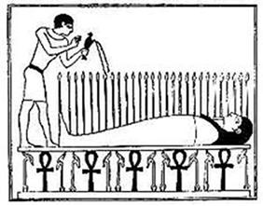
Public domain: Osiris-nepra. jpg Copy (The wheat stalks symbolize the resurrection.)
In his act of self-sacrifice, the Northern European creator god Odin (Wotan) wounds himself with a spear and hangs himself upside down from the World Tree; here, however, it takes nine days before he “finds the runes”—spiritual vision and knowledge, the spiritual dialogue (In Job: “Now I have seen you.”); Odin “cries out” and begins to “flourish” spiritually.
The Eskimo hero Rabe carries out his self-destruction—that is, the annihilation of his ego—by urging the giant whale to open its mouth wide and then jumping in of his own accord. He does not do this, however, without taking his fire drill with him, with which he cuts his way out of the monster after four days (Campbell: pp. 92, 200)
.We see the same thing in Heracles, who plunges into the whale’s maw to rescue Hesione, cuts his way out of this kind of tomb-like cave, and thus emerges victorious over matter.
Above all, it is the modern Enlightenment thinkers who associate these stages of the Prodigal Son’s experience with a plunge into the disaster of material life, the valley of tears. In Walsch’s Walsch’s biography, however, it is not three days but a year that he spends as a homeless man—on a park bench, so to speak—before his “Conversations with God” are revealed to him.
Exceptions with seemingly disastrous endings, such as that of Joan of Arc, are rare. This also applies to Goethe’s *Faust*, in which the path of the Prodigal Son is shown only as far as the heap of ruins (*Faust I*), but ultimately also the final goal of perfection at the end of *Faust II*, as the angels rescue Faust’s soul—which he had surrendered to the devil—“carry off Faust’s immortal essence.” (Chapter: The Burial)
Virtually everyone on the spiritual path experiences the sequence described above, in which, through some kind of rubble heap of material existence and the annihilation of one’s own ego “in the belly of the whale,” and then learns to follow the guidance of the inner voice, thereby realizing “Thy will be done.”
Like Buddha, Muhammad, Zarathustra, Mahavira, Krishna, Nanak, or Laozi, Jesus demonstrated the principle of ego annihilation and the steps to be taken (Sermon on the Mount). He pointed to self-knowledge as a divine being and also demonstrated through his concrete behavior how nafs, the instinct for self-preservation, the ego, must be broken down by eliminating “preferential love” and practicing universal love ruch (“As I have loved you”) .
The churches in the Middle Ages fought this path to perfection tooth and nail, and even today they remain silent on spiritual self-realization and perfection. One of their main tasks would be to show how people can meet the requirement of being perfect, what prerequisites are needed for this, and what dead ends exist—such as formal, blind faith.
Identifying with our Higher Self is therefore so difficult, because it is completely foreign to us to trust an invisible authority and surrender ourselves to it. Rather, we believe that, with regard to our lives and their purpose (Chapter 10), we are “ourselves”—as persons—actually responsible, even though we are “merely” agents. Furthermore, it is difficult to identify with our intuition because we have been accustomed to the forces of the external world from an early age. And finally, we have not even been made aware of its individual (!) existence. Although, each of us should know better that there is more than just the body, emotions, and mind—namely, our spiritual soul, colloquially known as our gut feeling or conscience.
Our greatest enemy in life is the false conception of the self—that is, of “me” as merely a material person—which causes us to lack the more important other half of our holistic self-knowledge. This conception is a one-sided view of our mammalian half, a complete failure to understand the statement that we are created in the image of God, and this failure ultimately amounts to a insult to the Creator. Despite their expulsion from Paradise, Adam and Eve did not lose their status as the image and likeness of God. In this respect, the primary goal of life remains establishing contact with our higher consciousness, which extends far beyond the earthly realm. Then the Prince (our spiritual consciousness, activated by flipping the “mixer lever”) has successfully made his way through the thorn hedge (the Valley of Tears, the herd of pigs) to reach Sleeping Beauty (the spiritual soul, intuitive guidance).
(For more on the specific ways in which one’s own person (I) can interact with one’s own inner guidance (I) in everyday life, see the upcoming Chapter 24: “Spiritual Life in Everyday Practice”)
__________________________________________________________________________________________
Comments
Eva says:
It’s nice to have this issue described from such different sources.
At the same time, I get the impression that the two sides are evaluated differently. The instinctive side is evil, and the side that rises to the “realms of high ancestors” is good. But what would God do without the material, active side? I guess he would soon get quite bored in his eternal peace, he would not be able to encounter himself in others and would soon long for the next Big Bang.
___________________________________________________________________________________________
jlang answers:
You’ll find the answer in Chapter 3. The instinctive side is there to drive us toward the spiritual side. It is the “evil” part that … always creates good. In this respect, there is nothing evil in creation, which is “very good” (Gen. 1:31). The only evil is what humans do to themselves and the planet. The reason is a misunderstanding of self-preservation. But more on that later.
___________________________________________________________________________________________
Kerrysek says:
Bravo, I think that’s an excellent idea.
Individual PET Forms | https://novopet.ru/
___________________________________________________________________________________________
Eva says:
Dear Jürgen,
Your comments are very interesting. I am impressed by the many quotes; you must be very well-read! And they largely coincide with my IFS model, working with inner parts, the inner family. However, I would disagree with Meister Eckhart when he says that the inner person is good and the outer person is evil. There is a lot of good in the outer person too!
I don’t like to divide things so black and white into good and evil, because experience shows that good also produces evil and vice versa. And it always depends on your perspective: for the tiger, catching its prey is good, but for the gazelle it is rather evil.
___________________________________________________________________________________________
Claudia says:
This article touched me deeply, thank you very much for it and I would love to read more like this.
Kind regards
Claudia
___________________________________________________________________________________________
jlang answers:
Hello Claudia, thank you very much for your kind comment. In fact, my daily experience is still, and now more than ever, that whenever I encounter a disturbance, a problem, or an unanswered question, I immediately enter into the consciousness of mirroring and then receive the solution, not always immediately, but always correctly (as it turns out).
Would you like more? You can have that, either in the form of more in-depth explanations of the statements on my website (which are very abbreviated versions of the respective topics and also only represent about half of the overall concept) or answers to specific questions you may have.
Go ahead!
Greetings from the rainy Harz Mountains.
JL
___________________________________________________________________________________________
Claudia says:
Hello Mr. Lang,
I found your blog while searching for help with “what is still important to me and how I want to live my life in the future.” Like you, I have been through some difficult times and am now trying to give my life a different direction and reflect on what I have always had: a strong sense of structure and a penchant for spirituality.
I find your blog extremely interesting and, above all, very multi-layered.
I am far from finished reading it, but I am delighted with every new page you describe in your entries.
Thank you very much for that!
Best regards from the Baltic Sea, where it is rainy today.
C
___________________________________________________________________________________________
Eva says:
I wonder whether more and more people are actually awakening to this knowledge and whether this could bring about a positive change in the brutality of this world. I would like to believe so, but I can’t quite believe it, as I haven’t noticed any development in this direction since I’ve been in this world. I rather have the impression that it is becoming more and more cruel. But maybe that’s just because of the one-sided news that we are bombarded with every day.
Regarding the description above: In this description, animals come across as very unenlightened, as lower beings.
When I watch my dog, I sometimes think he can meditate much better than I can. Or a tree, for example! Who’s to say it doesn’t meditate? And that it might not be far more advanced in this discipline than humans? Hm?
___________________________________________________________________________________________
Eva says:
That is explained very conclusively and is supported by many writings from around the world. What a difference a few small words can make in interpretation if they are not taken into account!
Thank you very much for this impressive collection!
___________________________________________________________________________________________
Nata says:
Yes, Jesus, the totally wise God, wow, of course that was his Higher Self, he spoke to himself and then asked himself on the cross why he was hanging there so beautifully. Why have you forsaken me? Oh, let the cup pass! Do you want another way for me? Ohhhh, the cup didn’t move x). Wow, how wise Jesus was, and his higher self, even today I still recognize it in the sweet tutu.
Wow, what a great soul plan and how clever his self was. It’s just funny that he was completely different and stupid and didn’t even understand his higher self x) “Why have you forsaken me?” Whyyyyyyy help me higher self, I’m so stupid without you, but you are me, aren’t you?
Then why don’t I know how beautiful I look hanging on the cross x).
So sarcasm.
If all people have a higher self, I’ll eat a broom.
Many are more likely descended from disturbed monkeys, and the rest from cooler ones. No, not everyone has a higher self, and if they do, it’s dead x) as stupid as they are x) IDIOTIC SUFFERING.
___________________________________________________________________________________________
RodneySlido says:
Прибарахлился: поменял взгляды на вещи.
https://www.threexvideo.com/super-hot-snapchat-couple-snapchat-username-sofia-kaylala/ | https://www.threexvideo.com/
___________________________________________________________________________________________
MarcusEcotT says:
Only a true friend can tolerate their friend’s weaknesses.
цена военный билет | https://g0g0.net/
___________________________________________________________________________________________
Eva says:
I still have my difficulties with that.
It would mean total surrender, and my controlling side is reluctant to go along with that. It feels responsible for ensuring that my earthly manifestation can live as long and comfortably as possible. But the higher self may have other plans, or none at all. Everything flows somehow, influenced by billions of things working together, such as the flutter of a butterfly’s wings in China, and I live well or badly, or I am infected by a virus and die. To accept all this with the stoic devotion of a samurai is really asking a lot.
But it is probably the only salvation from the psychological valley of tears and the pain that resistance to what is alone creates. So I will continue to practice bowing in humility before the great God who dwells within me and of whom I am also a part.
___________________________________________________________________________________________
jlang answers:
The spiritual path is comparable to that of a soldier. The soldier is provided with everything by his master: food, clothing, accommodation, a responsible job, and everything else he needs. This also includes a partner, family life, friends, rest periods, etc. In return, he has only one thing to do: obey, i.e., devote himself completely to his spiritual guidance.
The only exception to this parallel is that he not only risks his life in carrying out his duties, but in any case gives it up; this does not mean physical life, but the animal part, the ego program.