The ego wants nothing but itself. Everything that is not itself—what is, so to speak, the “non-self”—is alien to it and repels it. It denies, rejects, fights against, resists, strikes back and retaliates.
Denial is the essence of the ego. For to affirm would mean to understand a loss, an accident, a disappointment, an insult, an injustice, a stroke of fate, a reproach, a failure, etc., as a sign from fate—and perhaps to set out in search of the cause.
The ego wants only and exclusively itself. Everything that is not itself—what is, so to speak, “not-self”—Affirming everything, including the negative, would signify the wholeness and unity of all being and all events and reveal the realization that “everything comes from God.” However, this lack of understanding leads the ego program to fundamentally drive a person toward non-acceptance and resistance against things that are unpleasant to them. For it threatens self-preservation—not that of the person, but that of their ego. When, in their concrete behavior, they:
– grumbles, nags, criticizes, judges,
– makes accusations, shifts blame onto others,
– constantly reassures themselves that, fortunately, they “aren’t like them,”
– is impatient,
– hates adversity, seeks the good, yet means “good only for oneself,”
– overlooks the good in others,
– constantly compares themselves to others,
– and, above all, puts up bitter resistance against everything that does not suit them,
then this is a misunderstanding of earthly evil, which exists purposefully and painfully on the material plane, but is nothing other than a bundle of ceaseless attempts at redemption. It is:
“A part of that power,
which always wills evil and always creates good.”
(Faust I, Study)
This systemic denial is already evident at the start of a conversation, when it comes to complaining about the weather, no matter what it is. Above all, resistance is offered against every illness, rather than understanding it as an indication of physical or psychological disorder—and thus an absence of spiritual consciousness—and also as a call to remedy it through a conscious spiritual approach or step.
Resistance is offered against the competitor, the spouse in the battle for the children, the intrusive neighbor, or against doctors in cases of malpractice. In this context, the ego always immediately assumes the role of victim instead of asking itself why it was struck. It refuses to acknowledge that, in the world of good and evil, it is fundamentally the object of both good and evil. It imagines it has a claim to always getting only the best of everything and does not know that this happens only to spiritual seekers, those “under the umbrella.” It cannot know that it is only fundamental and comprehensive affirmation that creates peace. Above all, it does not know that denial and resistance cause suffering in life.
Since the ego does not understand the principle of the constructive function of opposites—like the positive and negative poles of a battery—and believes there are coins with only one side or batteries with only a positive pole, it always tries to pick the best parts out of the cake and avoid the unpleasant, instead of accepting whatever comes, because this is part of the “redemption” process from the good-bad world.
This is the human drama whose origin is described in the story of creation. In their conversation with the serpent, Adam and Eve may not be dissatisfied with their perfect state, but they are at least curious about the prospect of more. Since they have no experience with the material world and its good-evil nature, they have no basis for comparison and fall prey to the serpent. Thus, typical ego structures are already emerging, and they no longer affirm their previous state.
Through a spiritual way of life, however, there is an increasing dissolution of “opposites” through the recognition of their unity. This gives rise to a life in which evil—through union with the Perfect—increasingly ceases to exist, because in consciousness it is identified as an attempt at seduction and thus not evil in the spiritual sense. Negative experiences, such as bereavements, are perceived quite differently and thus lose their impact. This is what the Stoic philosophy of ancient Greece describes with the term ataraxia (peace of mind).
Negation is the cause of all human evil.
“I am the spirit that always negates.” The constructive opposite is found in the Odyssey, in which the Greek poet Homer describes the development of his hero time and again as “from the wrathful one to the enduring one.” We also find victory over negation in Jesus of Nazareth, who developed from “brood of vipers” through the inner struggle in the Garden of Gethsemane to the conscious acceptance and endurance of torture and death.
The opposite of negation contributes to the death of the ego: the acceptance or affirmation of everything that comes one’s way, as a Japanese Zen master demonstrates:
The Zen master Hakuin was praised by his neighbors as one who led a pure life. A beautiful Japanese girl, whose parents owned a grocery store, lived nearby. Then the parents suddenly discovered that she was pregnant and became very angry. The young woman did not want to admit who the man was, but after much insistence, she finally named Hakuin.
Furious, the parents went to the master. “Aha!” was all he had to say. After the child was born, they brought it to Hakuin. He had lost his good reputation, but that did not worry him, and he took the best possible care of the child. His neighbors provided him with milk and everything else the little one needed. A year later, the young mother could no longer bear it. She told her parents the truth: that the real father was a young man who worked at the fish market. The girl’s mother and father went back to Hakuin and asked for his forgiveness; they apologized at length and wanted to take the child back. Hakuin agreed. As he handed over the child, all he said was: “So, so!”
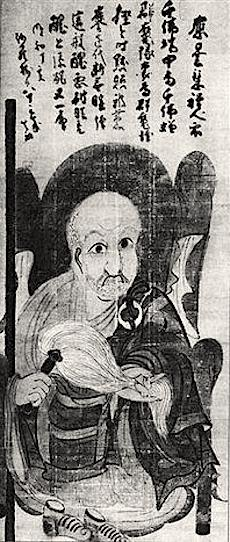
Zen Master Hakuin-Ekaku. 1767.png (b-w) commons.wikimedia.org
Hakuin understood that this adversity is in reality an arrangement of fate to advance his spiritual development,
that is, that of his consciousness. He offers no external resistance to any influences that beset him; he seeks to improve nothing that did not originate as an impulse from his soul; and he is dissatisfied with nothing. He knows that success in life depends on affirmation and is shattered by negation. Hakuin does precisely what the average person does not: namely, affirming the problem, the threat, the predicament. Dissatisfaction, negation, and resistance are essential characteristics of the human ego’s DNA. This characteristic is—as noted above—already laid out in the story of creation. While Hakuin was neither dissatisfied nor resistant, Eve did not even react to a real problem, but only to one the serpent had talked her into believing.
Hakuin does not want to solve anything by himself. He did not see himself as a victim; he trusted his soul and entered into acceptance. This lack of resistance is, in reality, the surrender of the problem to the spiritual power within him and the waiting for its whatever solution. This leads him out of the problem. He allows—to use a turn of phrase from Christian wisdom—the weeds and the wheat to grow together, so he does not try to pull out the weeds immediately; he allows them to be there and waits for the power of the soul, which in turn ensures that the weeds disappear. But in marriage or business life, indeed in all areas of life, especially in the case of illness, resistance and the desire to remove the problem are fundamental components of human behavior. On an international level, the superpowers’ policy of “regime change” comes to mind.
Hakuin’s behavior exemplifies the principle of tolerance, but it is incomplete for the everyday life of the spiritual person. First of all, it is of no use to appear to tolerate some terrible attack on me by gritting my teeth and keeping my fists clenched in my pockets while not reacting. For one does react, after all, with an inner surge of emotion. What matters is not reacting internally, remaining truly at peace in the truest sense of the word, and recognizing everything as coming from God. This can only work on the basis of understanding that I realize a spiritual test is currently taking place for me. Then I can calmly decide how to proceed externally.
This is, secondly, the struggle (Gita, Canto II). It happens that when others act aggressively—whether it concerns us personally or colleagues, partners, strangers, children, etc.—the spiritual seeker – the spiritual seeker should certainly intervene. However, this has nothing to do with retaliation, nothing with “an eye for an eye,” and nothing with the animalistic stimulus-response pattern, for in the case of deciding to engage in battle, consultation with the soul and ultimately its mandate to act have preceded it. So whether one allows oneself to be walked all over
(often) or not (also often) is a decision of inner guidance. In this respect, the solution lies neither in yielding nor in striking back, but in leaving the material plane of consciousness. It should be borne in mind that life fundamentally consists of struggle, but initially an inner one between the earthly motive of material self-preservation and the spiritual motive of the spiritual structure of universal preservation, which Jesus, in reference to the latter, describes as love for one’s enemies. Since this conflict is unknown to humans in the sense of being unconscious, this primary conflict does not exist at all from the outset, but manifests itself immediately and directly in the blind following of instinctual commands, such as rape or striking back.
“Heaven is within you
and so is the torment of hell.
Whatever you choose and desire,
that is what you have everywhere.”
(Angelus Silesius: The Cherubic Wanderer I, Verse 145)
However, people are unaware of this fundamental choice that Adam and Eve were faced with in the story of creation—in the form of the choice between the two trees. That is why they almost automatically end up in the earthly “lower” part of consciousness, with good and evil, with that of the animal: The past 12,000 years of Homo sapiens document this, despite the wisdom texts of all religions and the—albeit few—exceptions on the practical level of human conduct.
One of the world’s most important examples of the attitude of tolerance and consistent struggle is Gandhi’s life, which he fundamentally and practically placed, without exception, under the guidance of his spiritual soul:
“My whole life is imbued with the spirit of religion. I could not live a single moment without religion. Some of my political friends despair of me because they find that even my politics stem from my religion. And they are right about that. My politics and my other activities stem from my religion. I go even further and say that all the activities of a religious person must stem from his religion; for religion means union with God, that is to say: God governs every breath. For those who recognize this truth, God governs every action.”
(Chandrashanker Shukla: Gandhi’s View of Life. In: Fritz Kraus: The Spirit of the Mahatma. Baden-Baden 1957, p. 187)
In this respect, the cinematic masterpiece “Gandhi” is an absolute distortion of his motives for action, because with the exception of a single subordinate clause, no references whatsoever are made to the foundation of all his actions; indeed, they are virtually suppressed. This is not a criticism of the screenplay or direction: for in this, the mode of operation of the universal Maya (Skt.: Goddess of Veiling), the hidden principle of self-preservation, becomes visible.
As for the battle, God Krishna admonishes Arjuna:
“Why do you flee from the sacred (!) battle,
and cowardly avoid the clash, …”
(Bhagavad Gita II, 33)
What we fundamentally do not tolerate are the constant attacks of negative thoughts. However, we fight against them in such a way that, despite massive inner temptations from Mephisto, who wants to strike back, we immediately leave this level of retaliation and surrender to the soul’s perspective, so as not to give the negativities any room.
This is not easy. As an immediate response, we remind ourselves of our divine sonship; this puts a stop to the intrusion of negative thoughts.
No matter what storms in from the outside: the point is not to react in the sense of the aforementioned tit-for-tat. This is the exact opposite of the Jewish Tanakh teaching of “an eye for an eye” principle, which is nothing other than the archaic behavioral pattern of the lion. It is precisely about turning away from this reactive behavior, which consists of stimulus and response, yet people still react in exactly the same way: They go from A to B by remaining on the level of consciousness of the material world and believing that they can only survive by seeking revenge and striking back. Whoever strikes back without hesitation does not have God. With foresight, Shakespeare has Hamlet ask and then rhetorically answer himself:
“What is nobler: … to brave the sea of troubles? Or to endure the raging fate in spirit (!)?
“… like him who—though suffering all—suffers nothing: a man who accepts both fortune’s favors and misfortunes with equal (!) gratitude.” (Hamlet: III, 1; III, 2)
What does the conductor do when a passenger—who is about to miss his connecting train due to a significant delay and is therefore losing his temper—spits in his face? Reactions based on material consciousness will vary, but spiritually speaking, it will come down to not slapping the angry man, but rather recognizing what software drove him to his behavior, to further recognize what it is that provokes a desire to strike back, and finally, to realize why he, of all people, encountered me, of all people, in this specific situation, in order to replace the absurd talk of “coincidence” with karmic understanding. (This does not necessarily mean tolerating the offense, but everything else does not come from me, but through me from the soul.) Incidentally, this sort of thing does not happen to the spiritual person after the crucifixion of the ego; more precisely, it occurs only in very rare cases in connection with peripheral lessons on the spiritual path that still need to be learned.
The following classic example illustrates the ignorance regarding the inner choice between spirit and matter in general, and specifically regarding the subsequent practical choice between tolerance and struggle:
A course participant’s eardrum was so severely damaged by medical treatment that she became deaf in that ear. Beside herself with horror and rage, she wanted to sue the treating physician because she was certain it was medical malpractice. I strongly advised her against it, because disregarding the principle of non-resistance all too often leads to negative consequences. Two years later, I met her again. She complained that she had stood no chance against the combined might of the lawyers and that the lawsuit had driven her into financial ruin.
Now she had no connection to inner guidance and thus only a theoretical choice, for renouncing resistance would have required her to be able to trust her spiritual soul. Thus she followed the path of all those who do nothing but fight and seek revenge, because their victim mentality obscures all their own faults (especially karmic ones).
Even more disastrous are the daily battles over custody, because in these, not only do the two adversaries poison each other’s lives, but they also poison their children’s lives in the process.
Hakuin is a fictional counterexample to real-life models of properly understood forbearance in the form of not fighting against evil (Matt. 5:39). Gandhi, Martin Luther King, and Mandela demonstrate the connection between the inner struggle against earthly fear and the outer struggle—and, incidentally, tolerance—based on unconditional nonviolence. They took this principle to heart, which Meister Eckhart consistently expresses, quoting Seneca:
“What is the best consolation in suffering …: It is this, that a person accept all things as if he had desired and asked for them; for you would have desired them too, had you known that all things happen from God’s, with God’s, and in God’s will.”
(The Book of Divine Consolation, Chapter 1)
Whoever sits under the “shade of the Most High”—that is, has attained the awareness of their divine identity and the powerlessness of evil (cf. Chapter 15)—has experienced and continues to experience daily that their conflicts are indeed taken over and resolved by their soul. Their role in this is “merely” that of an active instrument carrying out the impulses of the guiding authority. If a struggle arises, it has a completely different character than a blind, furious reaction to an attack. It is particularly important to note that, for the ego, a struggle is practically always synonymous with violence. The struggles of the spiritual person always consist of the exact opposite: nonviolence. The classic example of this, as mentioned, is Gandhi (see below): “Violence is a sin against God.” But one need not be Gandhi to wage one’s struggles against the Quakers (George Fox) or against the rape of the climate or against hunger—without violence and with the recognition of the divine spark even in the opponent, who, in a spiritual sense, also “does not know what he is doing.”
Inner processing (decision) and, if necessary, external action follow the principle “Thy will be done!” If the X-ray of the tumor frightens me, or if I have been robbed or attacked and thoughts of panic or revenge fill me: Turn away from the world matrix, go within, and before the second part of the meditation—the silence marked by listening—ask for guidance: What is YOUR will, what should I do or not do? Then wait, and once you receive the answer, act courageously if necessary. Courageously, because it often happens that we must take paths that fall outside the normal framework and are frequently the exact opposite of what “common sense” tells us.
Non-reaction means that we block out the barrage of negative thoughts within us and do not retaliate outwardly. As mentioned, this does not mean not acting. Non-reaction has nothing to do with passivity. But there is a great difference between reacting and acting “in a just war” (Bhagavad Gita II, 31).
Reacting means getting even on the human level, while acting refers to the approach inspired from within, emanating from the soul: “Thy will be done!” or “Wu Wei.” Spiritual progress can be gauged by one’s mastery of forbearance and steadfastness in conflict.
Gandhi (see below) exemplified this by, on the one hand, enduring all violent attacks by the British (Salt March), and on the other hand, fighting consistently and unyieldingly against their colonial occupation on a spiritual basis (see below), in a completely nonviolent manner.

By Susant Purohit – Own work, CC BY-SA 4.0, https://commons.wikimedia.org/w/index.php?curid=53566194.
Gandhi’s Salt March was a remarkable chapter in the struggle for freedom against the British. Although our coasts produced salt in abundance, the British prohibited its use so that they could sell salt imported from their own country. Gandhi launched a massive movement to protest this British law and to defy it, so he marched to Dandi to launch the Salt March.
This is a 2D/3D sculpture at the Gandhi Memorial.
It is difficult to maintain tolerance in the face of the fierce urge of the animalistic element of self-preservation within us, for we are all raised with the principle: “An eye for an eye!”
Our biological heritage tells us to get even with those who have hurt us. And that is how people behave. That is why there are so many revenge movies. There are categorically no films on the theme of non-resistance and non-retaliation—except, of course, at Easter.
Anyone who seeks revenge or resists any threat or injustice fails to recognize the function of suffering (see Chapter 13): It is meant to drive home to us that we have not yet taken any steps to escape the realm of good and evil from which we suffer. And we have entered it because of our ignorance of how our purely material consciousness works and of how suffering functions as a whip to bring about the turnaround, to emerge from egocentric self-preservation and enter into the consciousness of the preservation of all (Jesus: “love of one’s enemies”).
Whoever seeks the way out of this vale of tears will grapple with the motivation behind the behavior of Hakuin and Mandela (renouncing retribution) and cease trying to improve the world around them. For there is nothing in creation to improve!
How can one claim such a thing when scarcity, deficit, danger, threat, misery, and hardship prevail everywhere? Since, apart from nature, everything we see before us has arisen through our consciousness, we can effect change only through a transformation of our own (!) consciousness.
Those who wish to improve the world without even touching their consciousness—which is, after all, the source of all these conditions—may achieve isolated successes, but they cannot change the overarching principle of the Valley of Tears. Environmental activists refuse to acknowledge this with their actions. On the contrary, their approach is based on a consciousness of lack: If they were to perceive the climate catastrophe as an impulse from the universe and allow themselves to be guided by it through intuition, they would improve the world at its root. Just as Gandhi led 300 million Indians to freedom.
Conventional medicine, among others, proceeds in the same way as the environmental activists; it is largely aimed at suppressing the symptoms of illness rather than addressing their causes and the causes of those causes. (This does not mean, however, that their medicine is inappropriate, for what would become of people—who, after all, act far more than 90% purely materially— without it. After all, medicine provides an immense amount of relief, even if it does not contribute to a spiritual transformation or lasting healing.)
Evil is not to be fought, but understood. Jesus never fought anything—except in his early days in the incident with the money changers—he only ever forgave. And in the case of illness, he said: “Get up, take your bed, and walk!” After all, he knew that illness no longer exists “under the shelter of the Most High,” even if symptoms—that is, temptations—are plentiful.
Whoever clings to their own mammalian self-preservation software—fighting, hating, striking back, defending territory, eliminating competitors, seeking revenge, exacting retribution, etc.— remains in the mode of the material world and must continue to live under the sword of Damocles of injustice, violence, misfortune, disappointment, unhappiness, misery, and hardship. The more people allow themselves to be blindly guided by the “eye for an eye” principle, the fewer eyes there are to see through the “bloody stage” (Shakespeare).
In doing so, people not only constantly wage war against one another, but also fight all spiritual ideals with far greater ferocity, because these would destroy the ego. While an enemy is an enemy to the ego, everything divine is, in the truest sense of the word, a mortal enemy.
All wisdom throughout the world has but a single goal: that this ego may die and true love prevail. Their defining characteristic is non-discrimination. Thus, for example, Gandhi fought the British tyrants but did not hate them. On the contrary, he knew only too well that they—like people in general—“do not know what they do.” Almost all have only one goal: to secure their own survival, although they can only survive if they shed this pattern and care primarily for others rather than primarily for themselves—and this, for the most part, exclusively. The life of the Nazarene served to represent the liquidation of the survival instinct—through love itself.
His physical death on the cross signifies the death of the self-preservation program, the death of the transient part of human existence. For consciousness, as the bearer of the enduring parts—mostly as the subconscious—reappears in subsequent existences (the karmic principle of continuity) and is, in fact, the very object of the individual’s processes of growth and maturation.
The point is to recognize that evil is a manifestation generated by human consciousness, which by its very nature lacks the power to harm us. It is fundamentally powerless, like the giant who can be defeated by a mere pebble. (The pebble symbolizes that this is a weapon with a long-range effect—not a contest of physical strength, but the use of strategy. In the case of Odysseus, it is the arrows with which he shoots the “suitors.”) So we do not engage in a physical struggle in this confrontation. The inner response consists of the awareness of the powerlessness of the threatening giant. If “Mister God”—as little Anna would say—is also on the other side, against what or whom should one resist?
Evil only fades when we stop wanting to get even with someone. Our zero-reaction involves refraining from “an eye for an eye” and, on the basis of meditation, leaving the fighting to the guidance of one’s spiritual soul. That is why Jesus teaches the monstrous truth: “You shall not resist evil!”
Our part in non-reaction is significant on the inside: We fight against the constant mental attacks that seek to suggest to us the necessity of the (survival) struggle. The countermeasures then take the form of arming ourselves with spiritual principles, such as the powerlessness of images of terror or the unity of all being—here, that of souls—and above all with “Gnothi se auton,” for which Jesus chose the term “love of one’s enemies” in the Sermon on the Mount, that is, the realization that God is also present in the enemy. We wait for inner impulses before or if we take action. This journey upward and inward signifies the decisive shift in dimension: We endure or fight bravely, but only as instruments of the soul and by no means of the ego. It does not matter whether I have a raging headache, whether my rent is being raised, or whether the neighbor is always too loud. We accept. We sheathe the sword because we know—and this is the crucial point—that on the opposite side of evil, God is also present, waiting for the turning of our consciousness; more precisely: not only waiting, but urging us toward this turning through the very appearance of this “enemy.” This is leaving the material plane and ascending into the spiritual one. Then the solution comes through spiritual dialogue or even gut feeling. In Jewish wisdom, this is expressed as follows:
“The Lord will fight for you, and you shall be silent.” (Ex. 14:14)
“I will go before you and remove all difficulties.” (Isa. 45:2).
In practice, there are various ways the soul resolves this, whether it involves an unfair grade, a marital war of words, being caught speeding with the risk of losing one’s license, a cancer diagnosis, or an economic collapse:
1. The expected consequences fail to materialize.
2. They occur, but are surprisingly mild, so that one can cope with them well.
3. The expected consequences are indeed disastrous, but in a short time, everything can be rebuilt through fortunate circumstances and providential events (Phoenix).
What might this look like in concrete terms: Suppose I have accumulated a massive mountain of debt amounting to several years’ income. I lose my job, my relationship falls apart, and I have to vacate my apartment. My economic and social existence is thus destroyed. But since I am aware that I have been led into this disastrous situation and will be led out of it—these are learning experiences on the path to liberation from the conditions of the Green World—I do not react like the average person, who panics and reacts catastrophically, ranging from apathy to alcohol, escape, theft, and robbery. Rather, I turn inward and wait with trust for salvation through my soul. The waiting involves many external trials and inner torments of fear. But if I do not give in, perspectives suddenly emerge. Helpers appear who first provide temporary shelter, then stable transitional solutions, and finally new sources of income. It is not they as persons who bring about the rescue, but rather they are instruments of the soul’s power through which they are brought into play. (Compare the film “Groundhog Day.”) ) The course of worldly development—superficially regarded by the outside world as a series of fortunate “coincidences”—leads to all obligations being settled and fully balanced, the legal consequences turning out leniently, and the restoration taking place in such a way that no one (!) has come to harm. Furthermore, the new way of life leads to the initial standard of living being significantly surpassed and harmonized to an unprecedented degree. A completely new kind of phoenix-like life has begun within the conditions of the stage world and continues to intensify both internally and externally in the sense of more than sufficient livelihood, freedom from fear, confident self-esteem, rejuvenation, and joy of life.
There is one significant exception to the principle of non-reaction: child-rearing. Adolescents depend on feedback from their educators to be able to understand their behavior and their place in the world. The first person to describe an approach to an appropriate reaction to misbehavior by children and adolescents was Rousseau in his educational work “Emile.” The focus here is not on the work as a whole, but on a specific point of his teaching: using the example of a difficult child, he describes the educator’s response to the child’s “destructive rage.” On the one hand, the punishment should, if possible, be structured so that it does not appear to be the educator’s decision, but rather a “natural consequence (!) of the bad deed.”
” Second—and this is the crucial point—he combines the punishment, that is, his reaction, with a “joyful embrace” of the child. (Jean-Jacques Rousseau: Emil, or On Education. Book 2: The Broken Windowpane) Anyone who, in educational practice, experiences punishing children’s or students’ misdeeds on the one hand, yet combines this with a hug or the assurance that they intend to embrace the child in question after the punishment is served and tell them that, despite everything, they are not angry with them, will witness miracle upon miracle regarding the power that love unleashes.
“Satyagraha”
In the face of all trials, the decisive factor in finding a solution is guidance from the “Father within me.” He is the only authority who always shows us the appropriate course of action in every situation. This may be consistent passivity, but it may also be courageous, nonviolent action. In this sense, non-resistance does not mean passivity, but rather behavior based on non-reaction and consultation with the guidance of the soul. The Nazarene’s way of life is exemplary in this regard. The feeding of the five thousand and his behavior in the Garden of Gethsemane can be cited as ideal examples of this. While we are humble, we do not always and not necessarily allow others to walk all over us. We are also quite willing to be led into battle if the opponent refuses to back down. Only when this is the case can it be revealed from within the silence. Then the attacks dissolve like morning mist under the sun’s rays.
What non-resistance concretely means can be seen in Gandhi’s approach. His credo was the so-called “Satyagraha”:
“I coined the term ‘Satyagraha’ in South Africa to give a name to the force with which the Indians there fought for a full eight years (1906–1914). I spoke of Satyagraha to distinguish this force from the movement that was then known in Britain and South Africa as passive resistance. The basic idea of Satyagraha is ‘adherence to the truth,’ which is why … I have also called it the ‘power of the soul.’”
(Mohandas Gandhi: Satyagraha. From the Congress Party’s report on the unrest in the Punjab.)
Gandhi understood Jesus. Non-resistance means “only” giving up retaliation; instead, one turns to inner guidance. How could Jesus have taught non-resistance if he had not recognized the powerlessness of evil? However, for those unfamiliar with this background, non-resistance is irrational, absurd, and leads only to the conclusion: Am I supposed to allow my own destruction? Or: Am I supposed to just let myself be taken advantage of?
Gandhi practiced seeing through things; he recognized God in the enemy as well. He knew that “everything (!) comes from God” (Jakob Böhme). He did everything to put this insight into practice: During his Satyagraha campaign in South Africa, the British railway workers there went on strike at the same time. This caused the British colonial government immense difficulties, which led Gandhi to suspend his movement for that period so as not to weaken the government, through which he could have easily achieved his political and social goals. This impressed the government so much that it ultimately yielded to his demands. (according to fboits-blogs)
The reaction of his opponents from the apartheid leadership is expressed as follows:
“I do not love your people, and I have absolutely no desire to do anything for their sake. But what can I do? You are helping us in our time of need. How can we lay a hand on you? I have often wished you would resort to violence like the English strikers; then we would know immediately how to get rid of you. But you do not even want to do anything harmful to your enemy. You wish to triumph merely by bearing suffering, and you never cross the boundaries of politeness and chivalry that you have set for yourselves. And that is precisely what condemns us to utter helplessness.”
(M. K. Gandhi: My Experiments with Truth. My Life.)
Gandhi was guided by the power of the soul and allowed himself to be led by it, as is impressively attested to by other accounts:
“Man’s highest task is to realize God, and all his political, social, and religious actions must be determined by the single goal of knowing God; but I am a part of the whole, and cannot find Him apart from the rest of humanity. My countrymen are my closest neighbors. They are so helpless, devoid of any means or initiative, that I must strive to help them. If, however, I were convinced that I could find ‘Him’ in a cave in the Himalayas, I would set out for it immediately. Yet I know that I cannot find “Him” apart from other people.”
(From: DIE ZEIT, 40/1987)
In his own way, Gandhi described the call Gnothi se auton—that is, to recognize one’s own spiritual identity—as humanity’s sole task on the learning planet Earth: For this triggers the return of the Prodigal Son from material to spiritual consciousness and the associated liberation from (material) good and evil. This means attaining freedom from suffering (see Chapter 13).
He saw that he could not wait for the many millions of Indians to open themselves to spiritual truth. He did everything “only for himself” so that this truth could take effect through him as a suitable channel for others.
Under the self-knowledge “Gnothi se auton,” the shift in perspective from the material person to the consciousness of the spiritual self of the spirit soul is already described, as in Chapter 1:
– “God does not look at the person” (Acts 10:34).
– “The kingdom of God is within you” (Luke 17:21).
– “The one who is in you is greater than the one who is in the world” (1 John 4:4).
His vision of improving the world has nothing to do with that of the countless idealists of this world, because his actions spring from his soul and not from worldly understanding. He liberated the Indian people from the brutal, bloodsucking regime of the British Empire. In principle, his approach was not resistance based on negation, but soul-driven action. Gandhi’s nonviolent struggles (e.g., his hunger strikes) were indeed risky external actions, but as a tool of the soul and therefore nonviolent, always serving the greater good and not harming the person of the enemy—in contrast to their ego.
Martin Luther King’s struggles were also spiritually inspired, for nonviolence is a characteristic of conflict that is foreign to the ego. The Gita’s second canto must also be understood in this context:
There, the inner god Krishna encourages the hero, who does not wish to kill his fellow men on the opposing side in the impending battle, to take up the fight (even if, in this two-layered situation with the adversaries, it is primarily the battles of the mind that are meant).
People’s worldly understanding is to always rush horizontally and directly from A to B on the material level in every endeavor and especially in every problem: one goes to the doctor, hires a lawyer, attacks competitors with words or even physically, etc. In our good-versus-evil world, these matters turn out well or badly, but often very badly. Hardly anyone—even when things get difficult—comes up with the idea or realizes that the path to a fundamentally good outcome goes through C.
When you want to reach someone by phone, you dial their number. But the dialing mechanism doesn’t connect us directly to the person on the other end. That is not possible, because then there would have to be as many cable ends plugged into the wall behind the telephone jack as there are subscribers worldwide. Rather, the call goes (via group switches as intermediate stations) to the central office; this connects the calling party to the called party via intermediate switches. The central office is a higher level from which communication—and thus “problem-solving” takes place. It brings about the attainment of the goal. In a spiritually successful life, one does not go from A to B, but from A to C (as in Central). This means that, for example, in the case of a lack of money or unemployment, one takes a step back from goal B (job) and, through meditation, distance oneself from the problem, handing the matter over to the Self—as C—and waiting for guidance. See Chapter 16 for how spiritual guidance from within can be attained.

For: “I, the Lord, am your healer.” (Ex. 15:26) For the doctor is not your Lord, but at most the instrument of spiritual guidance from within.
Jesus clearly demonstrated this when faced with the initially hopeless task of feeding 5,000 people (Matt. 14:19: “…looked up to heaven”). Turning inward is accomplished by everyone who possesses the knowledge that one can be spiritually guided and who has the ability to apply this knowledge appropriately (see Chapter 16). One “seeks”: “Seek first the kingdom of God [spiritual consciousness], and all these things will be added to you” (Matt. 6:33).
Did Gandhi take the path to C merely to use it as a means to an end and thus skillfully reach B? Did he therefore intend to use his inner guidance? No, he saw the plight of his people, went first to C, and was then led to B. Taoist wisdom symbolizes this by depicting Laozi riding a bull—without using the reins. The act of riding signifies that he has tamed the animalistic forces and holds dominion over them. Furthermore, the absence of reins indicates that he is not the one leading, but rather allowing himself to be led.
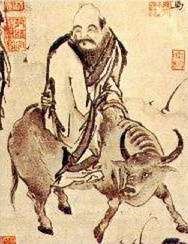
Laozi.jpg Commons public domain
The churches have attempted in various ways to circumvent or undermine the Sermon on the Mount’s teachings on non-resistance. They mostly take the position that these teachings are unfulfillable and derive various “theories of limited validity” from this.
In his Two Kingdoms doctrine, he divided the life of the Christian into two realms, the kingdom of God and that of the world: the Christian now lives in both at the same time. He should practice non-resistance toward everyone for his own sake. However, if he finds himself as a representative of the authorities in the fight against evil, he should indeed wield the sword (In: On Secular Authority).
Catholics prefer to limit this to certain groups of people and wish to restrict these elements to the clergy. (See Hilpert, K.: Between Harmlessness and Radicalism. On the Ethical Reception of the Sermon on the Mount.)
Anyone observing the bitter struggles of the churches—against literally everything that does not fit into their doctrine—would inevitably have to ask how they can reconcile this with the principle “Do not resist evil.” There are the constant and demarcations between denominations, the interference in people’s lives down to their most intimate spheres, the demonization of sexuality, the “disposal” of hundreds of babies’ bodies in a rubbish pit at the horror house of the Catholic nuns in Tuam, Ireland, the cover-up of countless cases of abuse within their own ranks, prioritizing the protection of the organization and the perpetrators over the protection of the thousands upon thousands of children who were raped (Catholic dignitaries in Pennsylvania; Black Book of the Evangelical Church), the drift from spiritual orientation into social spheres with denominational strangleholds, and much more. In any case, they will want nothing to do with the long-suffering Hakuin.
As for the trait of “prioritizing the protection of perpetrators over victims,” the obvious parallel to the Dieselgate manufacturers shows that this is not a specific trait of one group or another, but rather the universal ego in one guise or another. At every level of the church hierarchies, one can see what the self-preservation program does to the dignitaries.
Sheathing the Sword
The following quote—attributed to Rosa Luxemburg, Che Guevara, or Bertolt Brecht—is widely circulated and serves as the credo for denial, the ensuing struggle, and the fundamental discord among people: “Those who fight may lose. Those who do not fight have already lost.”
This is one of the creeds of the ego and is a slap in the face to those who endure, such as Joan of Arc, Jesus, Father Kolbe, and Mandela, and a grave error regarding the goal of harmonious coexistence, because it is based on the principle of retaliation.
Not fighting does not mean doing nothing. On the contrary, it is a tremendous effort to refrain from the reactive “eye for an eye” response in a conflict and to endure it, or, if necessary, to take up the ensuing external struggles under the guidance of one’s soul.
One does not rush to solve the problem, but to the problem-solver. Therefore, the above quote can be rephrased as follows: Whoever fights by striking back has completely lost all spiritual connections—or never had them in the first place—and knows nothing other than how to resist evil.
Evil depends on my consciousness; it is a superficial phenomenon and therefore only apparent. That is why I will not, like Peter (in Gethsemane), take up the sword, because I know that God is also on the other side. When I “put the sword back in its sheath” (a symbol of nonviolence), I thereby show that what stands against me is theatrical thunder, a temptation, and/or a test.
First and foremost, offering no resistance is not a question of action, but of inner attitude: If one does not perceive evil as evil but affirms it as a stimulus for growth and, at the same time, as a call to demonstrate one’s powerlessness, then one can—through active action—stand up for others and point out the path to salvation for them. This is what Buddha did for the people around him and what Jesus did for the Jews and the Romans. These were the initial sparks for the further spread of their teachings.
Gandhi did the same as a tool of the spiritual soul for the Indians. He recognized what the practical implementation of love for one’s enemies, acceptance, and active action—but nonviolently—can look like. This is not resistance in the sense of “an eye for an eye, a tooth for a tooth.” ” There is a difference between whether I try to respond to the attacks of an evil neighbor with countermeasures or whether I see the Son of God in him and, on this basis of consciousness, find a harmonious solution—then it doesn’t matter whether it’s with him or against him. In the first case, it is ego-driven retaliation that always leads to escalation, suffering, and war, and ultimately also rebounds on me through stress and disharmony. Those who rely on retaliation only increase the suffering. But those who place fighting in a spiritual context have a completely different perspective:
“Do not hesitate,
to fight in a just war
is every warrior’s first duty.”
(Bhagavad Gita II, 31)
What is “just” is not decided by my ego, but by my soul: “Thy will be done.” Because, as I said, everything is from God, my lung cancer, my bankruptcy, and my loneliness are, on the one hand, products of my previous state of consciousness and resistance to these phenomena, on the other hand, they are superficial phenomena that are essentially powerless and require only my own countermeasures when necessary. One of the first to teach non-resistance—using the example of water, by the way—was Lao Tzu:
“Because he [the Perfect One] blends in without resistance,
he lives without enmity or resistance.”
“Because he does not resist, nothing resists him.”
(Tao Te Ching 8; 22)
In Islamic mysticism, it goes like this:
“Do not fight fate, or it will fight against you!”
(Rumi: Masnavi I, 915)
In the three-dimensional world, my behavior is reactive, i.e., I react on the same level. I go from A to B, to the doctor, to the bankruptcy trustee, or to the lawyer when it comes to divorce, custody, or alimony issues. Since I remain within the material matrix of good and evil, the struggle ends either well or badly—more likely the latter, because I operate with a deficiency-oriented consciousness.
The state of our world is the result of non-acceptance, of rebellion, of denial, and thus of remaining on the material plane. This psychological profile of the ego is the sole cause of anger, discord, misunderstanding, aggression, and all suffering in this world. That is why the Buddha admonishes the “Brahmins,” that is, those on the spiritual path:
“Do not strike! Do not defend yourself! Woe to the one who strikes! Woe to the one who defends himself!”
“Endure abuse and disgrace without fault! Use tolerance as a sharp weapon!” (Dhammapada 389, 399)
Reactive struggle against something means: We exclude our own spiritual identity and remain within the realm of good and evil. Fights can turn out just as well as they can badly, which applies to brawls as much as to civil or criminal trials, to the War of the Roses, warning strikes, neighborhood disputes, etc. In any case, fights have winners and, above all, losers, and they change nothing about the state of the world because they remain on the earthly ego level. This has been evident for millennia. But whoever, like Luther King, leads the “righteous” struggle against evil, possesses an awareness of the abundance of a spiritual ideal that must be realized here and now through him. Those who fight on the ego level have an awareness of deficiency. They pounce on symptoms and thus remain slaves to their instinct for self-preservation, which they blindly follow. The most common strategy is the pattern “attack is the best defense.” This is the exact opposite of “daily ego-dying.”
We are born into this world of revenge and retaliation and know no other way. Religious institutions play a significant role in this. They disregard the teaching of nonviolence—of turning the other cheek. They suppress the teaching of nonviolence, of sheathing the sword. They invert the teaching of the Gospel into its opposite. Has anyone ever heard of a military chaplain offering to pray for the Taliban as well, for example in Afghanistan? How, then, do they understand the commandment “Do good to those who hate you”? ” A clear example of the church’s role is the sermon by the Wehrmacht chaplain at the beginning of the film “Stalingrad,” in which he incites the soldiers against the enemy. It feels like 99% of thrillers, crime films, and dramas are marked by revenge and retribution. Are there none that show non-retaliation, where the sword is sheathed and forgiveness is demonstrated?
Where is the counter-enlightenment from the churches here?
When it is necessary to fight, what matters is not doing so for the sake of a result, but simply taking action. For since I have entrusted the goal-setting to my spiritual soul, I need not concern myself with the result in my personal identity; it is, in any case, a matter for my intuition, my divine aspect. If I am advised to file a civil lawsuit, I go to court without regard for victory or defeat. Applied to sports or business, this means “renunciation of the fruit of one’s actions” (Gita IV.20 ff.), that is, acting without regard for the outcome.
The material human being fundamentally directs his actions—which are causally dominated by self-preservation—toward achieving his respective goal. The person on the spiritual path, upon fulfilling each of his intentions, surrenders it to his inner guidance, renounces it, and in this respect abandons every desire for personal fulfillment: “unaffected by the results of his action.” For he is well aware that between human intention and the desired result there always and fundamentally lies the divine will:
One’s own will >>>>>>>>>>>>>>>>>>>>>>> divine will >>>>>>>>>>>>>>>>>> one’s own goal.
This is the reason why many goals fail—or even those that are achieved but turn out to be a disaster—especially when it comes to choosing a partner, career goals, marital conflicts, or legal disputes.
The relevant phrase from Christian wisdom is: “Thy will be done!” But 99.9% of Christians merely recite this formula without realizing that, immediately afterward, they live out—unconditionally and exclusively—the exact opposite. They do not know that learning to surrender one’s own goals to one’s own spiritual soul is one of the essential components of the spiritual path of the Prodigal Son back (!) to spiritual consciousness—back to the “Kingdom of Heaven,” as Jesus most often put it.
The employee then goes to the office not only to earn a living, but above all to fulfill his life’s purpose. And then—and only then—is this behavior of surrender for the fulfillment of desires, despite all the vicissitudes of even spiritual life, always associated with freedom from suffering.
Hermann Hesse describes the motivation behind serving others—rather than a fixation on achieving personal goals—using the example of Siddhartha in his novel of the same name, in the chapter “Among the Child-People.” The person who thus renounces the pursuit of personal goals then sees himself as an instrument of divine will, as the rower of his life’s ship and not as the captain.
When I am ill, my first automatic reaction is not to fight against it, because omnipotence is already within me and because evil, like every phenomenon, is powerless. I am not healed by fighting it externally, but by surrendering to the soul.
Then (!) I find the appropriate paths, measures, medications, or even people who serve as tools to solve the problem, in case it does not resolve “on its own”—that is, through a shift in consciousness—and indeed as a healing rather than merely a suppression of symptoms, as is made clear by the example of Hakuin. He understands the principle that the Islamic mystic describes as follows:
“Thus God also afflicted Job and others, but they did not (!) ask that this divine affliction be taken from them.”
(Ibn Arabi: The Wisdom of the Prophets, Seth.)