A client reports: During an appointment with her gynecologist, he diagnoses a lump in her breast. A tissue examination reveals advanced disease (tumor) with extensive metastasis. At further appointments, she is given a life expectancy of only about six months. She quits her job and kicks out her unfaithful husband. Due to her loss of strength, she is no longer able to take care of the household, but since her daughter has just become unemployed, she takes over the necessary chores. She lies down on the sofa and begins to read the Bible.
After three months, all the lumps and metastases have disappeared. The doctors shrug their shoulders in disbelief, but cannot ignore the result and use the term “spontaneous remission.” “
She then takes up a new job managing spiritual events: she manages the schedules of spiritual teachers and organizes their seminars and lectures.
The famous parable of the paralytic (John 5) provides an insightful finding about the nature of paralysis. Jesus says to the paralytic:
“What is holding you back? Get up, take your bed and walk!”
The illness seems to be dependent on something, i.e. conditional. Without any external action – apart from the question of whether he wants to be healed – the sick man actually gets up. For 38 years, he has made his healing dependent on external help, which has not yet materialized. The Nazarene makes it clear to him that the overcoming of his suffering does not come from outside, but is within him and only needed to be activated.
There are many indications that evil, illness, dictatorship, terror, misfortune, etc. are not the power they appear to be:
Literature: Goethe has the devil say regretfully about the “virtuous” Gretchen, who has just come from confession and had virtually nothing to confess:
“… over her I have no power.”
(Faust I, Chapter 10: Street)
Epic: The story of the suffering of the ancient dramatic figure Odysseus is shaped by divine guidance. Concrete evil, in the form of the one-eyed cyclops Polyphemus, the son of a god, among others, relentlessly torments the hero, but ultimately cannot defeat him and, through his victorious battles, elevates him to a higher level of consciousness. Behind the evils is the sea god Poseidon, brother of the god king Zeus. Furthermore, Homer’s sirens simply cannot harm the hero as long as he does not enter their sphere of influence. This sphere is the belief in their power.
Fairy tale: The devil—or evil demon—explodes when one knows the code (!) to his fragile identity (Rumpelstiltskin). Or he flees for the same reason as in “The Devil and His Grandmother.”
Snow White cannot be killed by the poisoned apple.
Philosophy: The ancient intellectual giant Plato comments on evil:
“The way [ … to escape from evil …] is to conform to the highest good, that which evil can no longer harm and in whose sphere of influence it is powerless (!) …” (Theaitetos 177b).
Mythology: In the Norse legend of Siegfried, the dragon slayer (the dragon symbolizing evil, the serpent, the devil, etc.) becomes invulnerable after bathing in dragon’s blood. This shows that he could have become master of evil, with invulnerability as a result.
Jewish wisdom: It knows a whole series of symbolic events and conditions in which evil has no power:
In Daniel, it is the men in the fiery furnace who come out unscathed (Daniel 3).
It is Job, in which the devil is a servant of God who tests Job by taking everything away from him; but Job ultimately remains unharmed and receives back many times what he has lost.
It is also the parting of the Red Sea for Moses and the destruction of evil (in the form of Pharaoh’s army) at the last moment.
It is also the well-known story of David and Goliath, in which the youngster defeats the heavily armed giant warrior with a slingshot (a symbol of the power of thought, like Odysseus’ arrows).
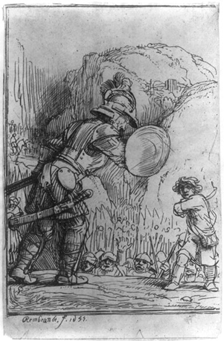
Rembrandt: David and Goliath. 1655
Wikimedia Commons: Metropolitan Museum of Arts Collection. Public Domain, CC0 1.0 public domain
Psalm 23, in which the person concerned need not fear misfortune, and Psalm 91 are particularly significant because they indicate the condition for immunity from material trials:
“Though a thousand fall at your side and ten thousand at your right hand, it will not come near you.” … This applies to those who are “… under the protection of the Most High…”.
Buddhism: The Pali Canon provides information about the nature of evil, here in the form of Mara, the “causer of suffering.” These are the Sutta Nipata III, 2 and then the following Samyutta Nikaya:
“Then Mara, the evil one, wishing to cause fear, trembling, and shivering in the Blessed One, went to where the Blessed One was. …
Not far from the Blessed One, he produced alternating appearances of light, both beautiful and ugly.
But the Blessed One knew that Mara was the Evil One, and he addressed him:
“Wandering in the cycle of births for a long time, you have taken on beautiful and ugly forms.
Enough now, you evil one, you are defeated, bringer of death! Those who are well-controlled in their actions, words, and thoughts are not subject to you, Mara …”
Then Mara, the evil one, realized that the Exalted One knew him, that the leader on the path to salvation knew him, and he disappeared on the spot, sorrowful and saddened.”
(Mara Samyutta, 1.4.3.)
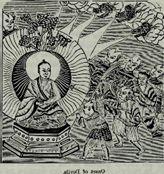
The dragon, image, and demon. 1887, DuBose, Hampden
Internet Archive Book Images, Flickr’s The Commons
The Buddha is saying that those who recognize evil, i.e., who become aware of its fundamental nature of nothingness, become immune to its consequences, so that evil must “disappear in sorrow.” Mara is the symbol of everything that causes suffering.
Hinduism: In the Bhagavad Gita, Krishna speaks to the seeker, revealing himself as the lord of life and death:
“… whoever … dedicates his actions to the deity will be as untouched by evil as a lotus leaf is by water.” (5:10)
Islam: The Sufis equate “iblis,” Satan, with the lower instincts, the “nafs.” These are the counterpart to “ruch,” the spirit, the divine soul in man. Throughout the theological history of Islam, Satan has not been given direct power over humans. He can only try to tempt them to evil, like the serpent in the story of creation or the sirens in the Odyssey. He remains an obedient servant of God, like Mephisto in Goethe’s Faust.
In his work “Javidnama,” Muhammad Iqbal sums up the role of the tempter by describing him as the force that ultimately leads humans to develop themselves further. Adam ceases to eke out his life with a limited state of consciousness, but learns to struggle under the pressure of suffering to overcome evil and thus to rise to the perfection that he did not fully have in paradise as a result of his limited consciousness—he knew no evil. In Iqbal’s work, Satan complains that people simply obey him too much. He does not enjoy such a lack of challenge. He wants to fight on equal terms with someone who could finally overcome him. He would bow down before such a person.
(Annemarie Schimmel: Muhammad Iqbal between Poetry, Philosophy, and Politics.)
Taoism: The master of ancient Chinese spirituality, Lao Tzu, addresses the problem of external power in his own distinctive way. He describes the consequences of recognizing its powerlessness:
“The wise man, certain of his inner god, cannot be held by any external power,
and no force can destroy him.” (50)
“Because he, master of letting go, is devoted to all , no one can harm him.” (66)
Children’s literature: In his famous children’s book “Jim Button and Luke the Engine Driver,” author Michael Ende describes Mr. Tur-Tur, a false giant who is huge when viewed from a distance but who, when approached courageously, i.e., without being deceived by appearances, shrinks and loses his enormous size.
Film: In “The Matrix,” the protagonist Neo, the “Chosen One,” succeeds in overcoming evil in the form of “agents” endowed with extraordinary powers through his spiritual development. Through this, he is initially able to dodge their barrage of bullets, later stop their bullets, and finally confront them directly and even penetrate them, initiating a process of fusion or unity to reveal their powerlessness and destroy them.
(The motif of merging with evil is part of many cultural traditions and is based on the recognition of unity with the “enemy.” It began more than four millennia ago with the ancient Mesopotamian creation myth Enuma Elish, in which the god Marduk allows his spiritual power to penetrate the dragon-like monster Tiamat, thus tearing it apart. In fairy tales, Little Red Riding Hood is devoured by the big bad wolf and yet rises unscathed. In the present day, Agent K in “Men in Black I” allows himself to be swallowed by the monster, thereby blowing it apart and emerging victorious. In fact, the theme of union with evil through inner (!) non-resistance and non-flight is central to the entire Christian doctrine. In this case, evil is not abolished altogether, but crumbles before those who stand in its way.
Jesus, standing before Pilate, expresses the powerful words on the subject of “the powerlessness of evil” by showing the Roman ruler his limits:
“You would have no power over me if it were not given to you from above…”
All these sources express something that seems absurd in everyday life. Everyone knows about the power of superiors, administrations, corporations, courts; we know about the power of terrorist organizations and their attacks, and some still know from experience the power of the secret police and the military.
Everyone has had personal experience with the power of serious illnesses, and we also know from history and the mass media about the tremendous effects of epidemics such as AIDS or coronaviruses. So how can it be that the wisdom of the peoples about suffering and evil asserts that these things exist, but do not have the power that we believe them to have? However, this only applies to “virtuous people,” “dragon slayers,” “cunning sufferers,” “boys with slingshots,” “orthodox believers,” and “people who are certain of their inner god.”
Some statements of wisdom go beyond mere assertion and reveal the conditions that apply to these outrageous claims.
To get a little closer to the nature of evil, it’s worth taking a look at its etymology: in Old High German, the word for evil, “bosi,” means “puffed up, swollen,” which can still be found today in words and phrases such as “in Bausch und Bogen” (in one fell swoop) or “Pausbacken” (chubby cheeks). The core meaning is that the phenomenon appears more extensive and worse than it really is, a false giant, so to speak. Nevertheless, no one can imagine that a diagnosis of “stomach cancer,” for example, could have anything to do with appearances and hot air. Rather, it is first and foremost a harsh physical reality, and no one would think of ignoring it, simply getting up, taking their bed, and leaving.
On closer examination of illness, the principle “as within, so without” is of primary importance, i.e., what is dominant in our consciousness (or rather, what we make of it) manifests itself in our environment due to its fate-shaping power (see chapter 10).
The counterpart to constant thoughts of fear and worry is a consciousness in which there is no room for negative attacks, no fears, no worries, no anger, no greed, only a sense of being protected: “… I shall not want.” This also applies in times of pandemic.
Illness is a phenomenon which – apart from childhood illnesses – indicates a disturbance of the soul, a deviation, so to speak, from the consciousness of the perfection of the soul with its material manifestation of unconditional health. This means that as long as I take illness seriously in my consciousness, i.e., perceive it as something evil—and 99% of people do—I remain in the material world of good and evil.
Our fundamental identity is the soul; its manifestation is our person. The symptom of illness is a signal that our hardware and software (physical and mental) are not in harmony with the course of the soul. Once we recognize this cause, we can live without illness, even if symptoms continue to appear to test our discipline and steadfastness of consciousness; for the understanding of the deceptive nature of illness must be kept constantly stable.
Accordingly, Jesus proceeds in the symbolic encounter with the paralytic, in which he asks him to negate his paralysis. This is known to all who have shifted their consciousness to a spiritual perspective – “God does not look at the person” – and have thus withdrawn from the influence of illness and all evil in general. (Exceptions for dental care and eyeglasses.)
As I said, this does not mean that one continues to be protected from symptoms. On the contrary, Mephisto never gives up, even if his attacks gradually become weaker when one remains steadfast.
Without spiritual awareness, however, he almost always prevails, partly because conventional medicine essentially understands healing as the suppression of symptoms, does not ask the spiritual “why” and therefore cannot prevent illness from continuing to exist individually as such.
Perfection consciousness and substantial health can only be achieved by opening oneself to the inflow of the soul. When “striving” dominates, i.e., concentration on one’s own divine identity, there is no longer any room for worry, fear, anger, and greed. Only in this way can such worldly improbable goals as freedom from worry, health, prosperity, interpersonal harmony, peace of mind, fearlessness of evil, and love of one’s enemies be properly understood and achieved. Without a spiritual basis—not even with positive thinking, for example—this does not work. Through ignorance, we have surrendered our dominion to accidents, burglars, pathogens, economic fluctuations, governments, rampagers, assassins, etc., in short, to external dominion, even though it is within us. Through a change in consciousness, however, we deny any power of external instances – over me – and transfer it back to its rightful place, our inner self.
In this respect, it is not evil that is the power, but the orientation of consciousness toward evil, which is only a provocateur, like the devil in the desert. If I believe in the power of evil, it becomes real through the creative power of consciousness. Seduced (!) consciousness is the cause of evil, and real evil is its effect. We ourselves are therefore the creators of the power of evil because we fall for it. Those who allow themselves to be intimidated by the threat of alimony payments, job loss, a cancer diagnosis, or bankruptcy become real victims of these threats: “What I feared has come upon me,” Job laments. It is a matter of perception. Jesus denied the power of external appearances (the death of Lazarus, the paralytic’s bedridden state, Pilate, etc.). We can do the same with COVID-19, diabetes, anorexia, hypertension, etc. But if I change the cause, the effect changes. Their fundamental powerlessness does not mean, however, that one cannot be severely affected by them. But ultimately, we emerge unscathed from the fiery furnace because we have not relinquished the regained unity with our spiritual guidance.
“Whoever holds fast to perfection [self-knowledge of one’s own divinity, unity with the soul], poisonous snakes will not bite him.”
(Tao Te Ching, 55)
The human drama on this planet consists in misunderstanding the manifold references in the wisdom scriptures, for evil such as accidents, poverty, illness, enmity, and war do not actually exist as a principle at all. It exists only as an image, as a seduction. It exists only as a provocation to doubt the idea of creation. Evil in this world exists only because people see and believe that evil can exist in this world and that it manifests itself.
In other words, the moment I recognize evil as merely an illusion that attempts to mislead, precisely because it cannot be part of creation, it cannot become reality for me and must dissolve. However, if I believe that it can really threaten me and become dangerous to me, it unfolds its terrible destructive power.
Homer gave this phenomenon the immortal form of the sirens, who cannot harm anyone as long as they do not fall into their clutches. Goethe gave the temptation of the serpent the form of Mephisto, who was given the task of temptation by the “Lord” to distract Faust from his search for God.
The doctor is to be led into the abyss of de-spiritualized, purely material faith. In other words, Mephisto himself has no power whatsoever to lead Faust astray from the path of salvation; he can only tempt him. (He cannot even leave the room without the pentagram: Study Room I). Consequently, Goethe limits the devil’s work to “tempting” (Prologue in Heaven). Mephisto cannot do anything evil himself; Faust must become the perpetrator himself. If he ignored Mephisto and did not think anything evil, fearful, or greedy, nothing evil could happen.
Even in the world of fairy tales, it is not without reason that the pure theme of seduction is frequently found as a distraction from powerlessness, whether in Little Red Riding Hood, The Wolf and the Seven Little Kids, Brother and Sister, Hansel and Gretel, The Bear Skinner, The Devil and His Grandmother, Snow White, and many others. The temptation can also be found in medieval epics such as Parzival during his childhood. In all these stories, after straying from the path to spiritual identity (Little Red Riding Hood “strayed from the path”), there are dire consequences (Snow White eats the poisoned apple), but above all, there is their powerlessness against evil. The evil stepmother does not succeed in destroying Snow White.

Ugly Witch Giving Red Apple. Vectoral Illustration. White Background Isolated. iStockphoto-1131251454

Young people becoming involved in criminal activity. iStockphoto-475857705
When Buddha—like Agent Smith in the movie “The Matrix I,” by the way—understands the world as one of suffering, he is describing the symptom. But in principle, it is “only” a seduction into suffering. Through this temptation, humans are supposed to ignore the goal of “THY will be done” and realize the ego deviation of “MY will be done” – this is the only reason why wars exist. They are supposed to accept evil as an independently given part of reality and as unchangeable. The temptation is intended to make us consider our world to be objective, instead of recognizing its dependence on our consciousness. And we should by no means recognize the powerlessness of evil.
But evil or suffering is not only corruption, but also an instrument for escaping it.
The sentence from the Lord’s Prayer, “And lead us not into temptation,” is absurd for spiritual people. A meaningful version would be “And lead us into temptation.” For without the agonizing temptation to stray from the path of the soul, we would never find our way out of the world of the surface and back to the truth of principles. We would waste our lives in suffering, without any prospect of further and higher development. Suffering is the whip that drives us back.
If the enemy, as an opponent in a lawsuit, competition, or divorce, brings out his artillery and I react, there will be war; if, on the other hand, I perceive this threat as theatrical thunder, because I know that everything comes from God and the enemy is my neighbor and is just as much an expression of the divine soul within us, the bottom line is peace. If I try to evade my maintenance obligations because I am unaware of the soul’s responsibility for my provision, the arm of the law will catch up with me at some point; but if I accept these apparent restrictions in my household budget with a shrug and trust in my divine provision (see chapter 19), my standard of living will remain unchanged.
The question of the meaning of human life can only be solved by recognizing the true nature of evil. It only pretends to have power. We are tempted, enticed, seduced to believe in evil instead of relying on the protection of our inner God and His provision. Spiritual reality with its laws supersedes material reality, just as federal laws override state laws (see the Hessian state constitution, which still enshrines the death penalty). We live in a world where most people have accepted the embedded seduction. But how could Jesus have taught us to laugh in the face of illness, to simply get up and walk away? Incidentally, he never tried to fight evil, e.g., to fight the storm, but simply said, “Shut up!” “Lift yourself up!” “Step forward!” “Get up!” etc., thereby rejecting evil as an attempt to manipulate one’s own consciousness.
To put it bluntly: the incomprehensible human suffering can be overcome if we recognize evil as a bogeyman, as a false giant like Goliath or Turtur, and as an attempt to incite us to respond to it. Then, with spiritual awareness and the appropriate experience, we can simply smile at its martial appearance: “… it will not touch you.”
(However, this is easier said than done. The level of spiritual insight required for this can usually only be achieved after a long period of severe trials and great discipline in perseverance, in order to be guided safely through the dangers and temptations of the spiritual path on the basis of dialogue with one’s inner guidance.)
“It won’t touch you…” sounds like a slap in the face to the countless people who live lives of great suffering, who are confined to their beds or wheelchairs in agony, who have to live with artificial colostomies or who are exposed to disfigurement, homelessness, chronic unbearable pain, torture, rape, bombs, or ethnic mass murder. And yet, with the appropriate spiritual awareness of the omnipotence within, as Jesus made unmistakably clear, it is enough to get up and walk away. The endless torments are nothing more than the symptom of the equally endless distance from one’s own soul, which makes itself known in this way and wants to move the sufferers to return.
Only if Odysseus were to “approach” the sirens would they tear him to pieces (Canto 12, 39-54, 173-197). Homer uses the terms “listen to them” and “touch their dwelling” and describes the surrounding mountains of bones of those who have fallen into their trap. This is precisely the case with Faust: he listens to them, succumbs to the temptations of power, conquest, amusement, and violence, and consequently wreaks bloody havoc. In this respect, Homer’s epic with its mountains of bones, Jesus’ appearance before Pilate, and Goethe’s drama prove to be works of enlightenment for people of every age.
However, not falling for the sirens is not something that can be easily achieved in real life. Odysseus even has to be tied to the ship’s mast. (The mast is the symbol of the antenna pointing “upwards,” the vertical line to God.) With the symbolism of bondage, Homer shows that the efforts to connect with the soul and to attain knowledge of one’s own identity must be conceivably intense and narrow in order to rob the ego of its freedom of movement. Without direct dialogue with one’s own intuition, with the “goddess” who prepared him for the “sirens,” the temptation cannot be overcome.
The price of immunity from suffering is high; it cannot be had for free. To put it in symbolic terms: returning to paradise is not made easy for us; after all, two heavily armed angels guard the entrance. And in order to achieve dialogue with the goddess, i.e., one’s own inner voice, one must expend a great deal of energy, time, and resilience. This can take years, even many years.
The credibility of this description is poor, because there are not many who are willing to take the risk of ignoring the threats of evil, perhaps even allowing themselves to be “devoured” by it for a while, even spending a few days in the “belly of the whale” and perhaps even writing about it. But the ultimate appropriation by the apparent evil is in reality its very last act of strength to perhaps still prevent its defeat. The spiritual seeker is only led into this final struggle when self-knowledge as the son of God and the corresponding resilience have developed to such an extent that they are sufficient for this trial by fire. There are plenty of symbols for this showdown, starting with Little Red Riding Hood, who emerges unscathed (!) from the wolf’s belly, as well as Jonah from the whale’s belly or Joseph from the cistern. Agent K in “Men in Black I” allows himself to be swallowed by the cockroach, thereby blowing it up with his weapon, thereby surviving and thereby becoming the savior of mankind. In a very symbolic way, Gandhi allows himself to be “devoured” many times by the British occupying power, namely imprisoned, thereby exposing their role as evildoers and becoming the savior of hundreds of millions of Indians. The same applies to Quakers such as George Fox in 17th-century England, to Maximilian Kolbe in Auschwitz, and to countless very real heroes, law enforcement officers, lifesavers, and whistleblowers who allowed themselves to be “devoured.”
These lines cannot have been written without having experienced firsthand the drastic experience of being led into catastrophe with one’s eyes wide open, equipped with the knowledge of the powerlessness of evil, but without the corresponding experience, i.e., without the ultimate proof. Then comes the painful experience of feeling one’s way step by step along the edge of a sword over the abyss and being led out unscathed. (Another way of expressing this Hindu wisdom is “dancing on the heads of snakes.”)
I suffered the loss of everything I had, the loss of family life with my partner and children, the loss of my job and thus my income, eviction proceedings and loss of the roof over my head, combined with unbearable debt and legal and financial attackers from all sides. The almost hourly “conversation with the goddess Athena,” with my intuition, my inner voice, was my basis for the strength to wait, to endure the terrible suffering, to remain steadfast, and to watch how my inner guidance would solve the problem.
I was not able to go through the trials completely free of fear, but I was able to go through them confidently, constantly supported by encouragement from within. The unscathed ascent from the lion’s den was the demonstration of the truth about the connection described, the powerlessness of evil.
The sea monster spat me out again; the “daily dying” had reached a temporary peak. (Homer has the goddess Circe say that Odysseus will “taste death [of the ego] twice.”) After this rebirth and a period of rehabilitation, supercompensation began to take effect, and in the following decade I realized that I was better off than ever before, both in terms of consciousness and material circumstances, and above all that my life had taken on an even deeper meaning. If I had not experienced the powerlessness of evil myself – later on several occasions – all the biblical and other impressive parables and symbols would have been worthless.
External powers do not lose their influence altogether. Because evil only loses its power through collision with the power of the soul, its loss of power only applies to those who have consciously faced the experience of the powerlessness of worldly power. This is always the result of difficult internal and external struggles in which the old belief in external power factors is shattered by new experiences of their powerlessness. In the outside world, it would not be the case that, for example, as a soldier on the front line, bullets bounce off you, but that with spiritual awareness you do not even get there in the first place. The suffering of others continues there. Ultimately, it is there to lead to awareness.
The knowledge of the powerlessness of evil must not be used. It has happened before that spiritual aspirants, in the exuberance of this realization, decided to go to a harbor tavern and start a fight there: “Nothing can happen to us!” This ends badly because the ego wants to take the place of the soul.
The worldly power of evil is enormous, but only because our collective consciousness has allowed it to arise from the beginning and always has. This consciousness cannot distinguish that evil does occur, but does not have the power it pretends to have. After Homer, Plato, Buddha, Shankara, Jesus, Job, Lao Tzu, and of course the Gita, hardly anyone in the Middle Ages emphasized the fundamental powerlessness of evil. It was not until the modern era in the mid-19th century that translations of Eastern texts appeared. Only then was the toothlessness of evil taken up by modern spiritual teachers, especially from North America, such as Joel S. Goldsmith.
Powerlessness does not mean that evil gives people who are aware of its powerlessness a wide berth. On the contrary, it wants to attack them in particular in order to prevent the discovery of its own principle or to maintain its mode of operation and thus the suffering of human beings. For this is the key (Mephisto’s mission: Faust I, Prologue in Heaven), the instrument for achieving freedom from suffering. The vernacular occasionally hints at this with the saying “otherwise they will not learn.”
Spiritual seekers already feel Mephisto’s influence in the form of pain, divorce, and the loss of income that initially causes them distress. This is precisely the test situation in which it is important not to be afraid, not to allow worry, and to rely on the guidance of the Higher Self. This is tested extensively. The ego program then fires broadside after broadside at the insolent person who dares to probe and see through the Nazarene’s thunderous statement that Pilate actually has no power. It wants to make him suffer for it, risking that the truth seeker will see through and endure this very suffering. This means that worldly power initially affects the spiritual seeker, but only as affliction and not as destruction. The affliction is temporary, and Mara must retreat (see above: Mara Samyutta).
These experiences make it clear that there is a power of evil, not as a principle of creation, but only as a phenomenon, as a symptom. Then the meaning of the powerful statement “Fear not!” also becomes clear: there is nothing to fear. Then one can stop fearing one’s cancer. This does not mean stopping attempts at healing, e.g., refraining from vaccination or cancer therapy. Mohammed is credited with saying that you should trust in Allah, but still tie up your camel. It is about leading the inner struggle to success and trusting that and how the inner voice will then guide the outer action: “I can do nothing of myself, the Father in me does the works.” One is then freed from responsibility, having passed on the problem-solving to one’s inner genius, and takes the next steps as a tool and a co-worker.
The libretto to Mozart’s opera “The Magic Flute” calls these procedures the trial by fire and the trial by water. These terms are obviously borrowed from the esoteric tradition of the late Middle Ages. The trial by fire refers to the burning of the veil that obscures the view of the essence of appearances. This applies in particular to seeing through the mask of the outer person to his soul.
The trial by water refers to the situation that every spiritual seeker encounters when all material means of rescue have been exhausted and the initiate, with the best will in the world, has no choice but to cling to his inner god. The classic example is the hopeless situation of Odysseus in the breakers of the sea whipped up by Poseidon, in which, clinging to the last beam of his raft, he follows the advice of the sea goddess, lets go (!) (cf. Hermann Hesse: Klein und Wagner) and jumps into the raging floods of the hurricane (Fifth Song, 339-375). The sea goddess calls out: Trust me! Let go! “Jump!” This shows the nature of the situation, namely that of a test, a temptation, and also the powerlessness of the threat.
For example, someone who, after their divorce, refuses to accept that half of the family income has suddenly disappeared, but the costs of child support, rent, and electricity have remained the same; someone who then ignores the fact that this is slowly accumulating a debt of almost two years’ salary; someone who then has no money left and is facing eviction, and is told from within: “Quit!” and does so, still does not know that the crucifixion of his material consciousness is imminent and with it the time in the belly of the whale, the “dark night of the soul.” But then they learn that they have washed up on “Ithaca” on the spiritual level, now have very solid ground under their feet, and that despite numerous subsequent struggles, everything turns out for the best and a completely new way of life based on spirituality has begun. At this level, all evil is now absent and a completely different new harmony with security and new love prevails.
If we have remained steadfast in our belief that there is no power other than that of our soul, and therefore, figuratively speaking, Mephisto must meekly admit that there is nothing but divine omnipotence, including himself, the darkness dissolves in the bright light of knowledge. A helpful mantra is always that God is also on the other side!
We are not under protection when we fear external powers such as authorities, medical diagnoses, burglars, attacks, war refugees, job loss, etc. Then we are subject to the vicissitudes of the good-and-evil world. When we fear the power of people, accidents, and inclement weather, we reap them. It is the dilemma of everyday people that they believe in earthly powers because they were born into this belief and its superficial experience. For them, evil is very real, and then it becomes so. In this respect, our horizontal life experience is our seducer, which, like Mephisto in Faust I, does everything to distract us from our search for God and meaning. For as an obedient servant of God, he is supposed to cause as much suffering as possible, because this is the only language that people understand, so that they finally embark on the spiritual path to liberation from suffering.
There is no parallel power. Everything is omnipotence, everything (!) “comes from God,” to quote Jakob Böhme once again. Therefore, evil is not original reality, but only for the people who have made it so by falling into its clutches. For those who see through its mirage-like nature, it is not only powerless, but not even there. Only occasionally, in retrospect, does one realize that all the unpleasant, dangerous, or terrible circumstances under which humanity as a whole lives, from storm disasters to virus epidemics, divorces, and financial collapses to job losses, etc., did not even affect oneself.
But even if they have retained a remnant of their connection to God, people are unconsciously convinced of the existence of other parallel powers alongside omnipotence. In most cases, however, they no longer have any spiritual connection at all. They do not see the function of evil, which is there for our higher development.
Mick Jagger of the Rolling Stones sings presciently in “Sympathy for the Devil”:
“But what’s confusing you,
is just the nature of my game.”
Without evil and suffering, we would continue to waste our lives without understanding, meaning, or purpose. It has the meaning that it always “creates good.” (Faust I, Study Room I) It is always there, but nevertheless substantially void. Without evil, there would be no overcoming it. This is comically explored in the film “Bedazzled” with Liz Hurley.
As far as evil people are concerned, evil does not originate in them, but in the collective consciousness that evil and, above all, evil people exist. This includes the erroneous belief that there is something outside of God that has power. And this power always manifests itself as the power of deficiency and evil.
The effects are correspondingly composed of both good and evil. The worst thing that can happen to people—and this is exactly what happens to them constantly and fundamentally—is to attribute power to a circumstance or a person, instead of assuming that their power springs from general and personal consciousness and has no influence on me as a mere child, but one equipped with my *catapult of mental power. The Pilates of this world can do whatever they want: my recognition of the non-power of external influences causes their failure for me. Their power then shatters like Goliath’s against a pebble. This also applies to earthly norms, rules, and laws. This does not mean that they can be ignored at will. On the contrary, they must be observed, as everyone else does. But in the event of a conflict, when worldly and spiritual ideals collide, I disregard the former: when the draft notice comes, I obey it, but when it comes to killing, I do not. The Silesian mystic writes:
“The saint, whatever he does,
does nothing according to the commandment.
He does it purely
out of love for God.”
(Cherubinischer Wandersmann. Book 5, 276)
Similar statements can be found in the anonymous author of Theologia Deutsch, the “Franckforter,” chapter 30, or in Paul’s Epistle to the Romans. One cannot say or write anything about the specter of the power of evil without experiencing its impotence. This is only possible through bold, concrete action into the unknown, like Columbus. From a worldly point of view, such a step into an unclear and dangerous situation is risky. But anyone who consciously asserts themselves, based on and presupposing a conversation with their inner voice—the extension of their gut feeling, so to speak—in a situation in which the army of cancer diagnoses, bailiffs, job losses, lawyer threats, loan terminations, eviction orders, etc. and then bounce off you, ineffective because of your knowledge of their powerlessness – even if this is accompanied by really critical phases – then Goliath’s threat has become irrelevant. You get up, take your bed and walk away. In Jewish wisdom, this is symbolically processed through the situation of Moses, who stands with his people on the seashore, already has Pharaoh’s chariots in sight, and for whom the sea opens up and forms a passage for his escape. For those who have experienced that this actually works, circumstances change. This means that when I recognize evil as an inflated conditional reality, it begins to disappear for me. For those who understand that the world is only and exclusively good, even very good (Gen. 1:31), it actually becomes only good.
This does not mean ignoring evil. Rather, it means perceiving evil as a phenomenon and a product that has arisen and been activated due to an ingrained consciousness and can be deactivated through a radical change in consciousness. It does not exist independently.
The children sitting in front of the stage watching Kasper beat up the crocodile currently consider the scene to be reality. Adults sometimes do the same when they duck down in their cinema seats when the truck on the screen is racing straight towards them. Of course, the Kasper figure and the crocodile are actually real, but it is the conditional reality of the puppet, the surface. The children do not realize that the puppets are being guided by the puppeteer’s hands. It is the same with people. The hand in the puppet is the substance level, i.e., what is constant, what remains. The stage is dismantled and the puppets disappear into storage after the performance, but the puppeteer’s hands remain. Substance eludes perception, while it appears in countless variations as appearance:
“I am not visible to everyone,
because the ** Maya illusion veils me,
so that the world, confused,
no longer sees me behind a thousand masks.”
(Bhagavad Gita 7.25)
__________________________________________________________________________________
* David’s slingshot corresponds to Odysseus’ bow and arrow. As far as the bow is concerned, it is no coincidence that the hero in Kubrick’s film “2001: A Space Odyssey” is named Bowman.
** Maya: In Hinduism, the goddess of illusion who veils the life behind life, obscuring the view of the hand in the glove.
___________________________________________________________________________
Thus, every human being is, on the one hand, an expression of divine life and, on the other hand, an expression of his or her personal consciousness in a mixture of good and evil. Evil cannot exist in “God’s kingdom,” i.e., developed spiritual consciousness, because the world is “very good.” At least in principle, humans are free to decide whether and when to choose a way of life within the broad spectrum between very evil and very good. Since they have learned to accept that evil with its immense power also exists due to the evil that surrounds them, the manifestations of evil become reality. They have then found a stable place on the hard drive of our consciousness and are expressed accordingly on the monitor of concrete life.
The essence of evil is its nothingness. If I can perceive evil as only an appearance and persistently reject it, it dissolves. The real evil is the temptation to believe in the worldly surface and to distract from the essence behind it. This is already encapsulated in the story of creation: what was a problem for Eve in her dialogue with the serpent did not exist at all. At the instigation of the serpent, she interpreted it as a problem, took it into her consciousness, and thus helped it become reality.
A classic example of this connection is the hypochondriac, the imaginary sick person who searches so intensely for symptoms of illness that they become more and more a painful reality for him. He does this because his low self-esteem literally drives him to find some kind of pain so that he can feel it and thus feel himself. Another example of the power of consciousness is the effect (!) of placebos.
It is, of course, difficult to imagine explaining the fundamental insignificance of evil to, for example, a couple who have lost their daughter to a sex offender and who naturally divide the world into good and evil. This can only be done spiritually and is also multi-layered in the sense that life is indestructible, that there are karmic determinations, that focusing exclusively on the material surface is misleading, that there is a way to escape the good-evil life, and that grief is, cruelly, also an indicator of distance from one’s own spiritual essence.
How evil dissolves takes many different forms. In any case, the prerequisite is always not to react internally (!). This does not mean not acting. But the action prompted by the soul only takes place when it indicates the appropriate way and the appropriate time (kairos). If, for example, the situation is precarious after a financial collapse or loss of employment, one will not fall into activity and frantically try all conceivable external means first. Rather, one will turn one’s consciousness inward and concentrate on seeking:
“Seek firstthe kingdom of God … and all these things … will be added unto you.”
By “Kingdom of God,” Jesus refers to the consciousness—also referred to elsewhere as the “Kingdom of Heaven”—that trustingly relies on the soul’s guidance and provision and waits until the right moment for a suitable constellation to appear that will solve the problem. Leo Tolstoy wrote on this subject in 1884 in his work “The Kingdom of God Is Within You.” Its title refers to Luke 17:21, in which Jesus answers the Pharisees’ question about when it will come and where it is located. John uses the words “He who is in you is greater than he who is in the world” (1 John 4:4), while Paul succinctly formulates it as “Christ in me” (Gal. 2:20). (1 John 4:4), whereas Paul formulates it succinctly and concisely as “Christ in me” (Gal. 2:20).
Those who rely on the workings of this consciousness know that the timing is determined by the soul. One is not a responsible actor, but a cooperative executive organ.
Recognizing the nature of evil is crucial for success or overcoming it. If I manage to shrug my shoulders and smile at every evil manifestation, the threat dissolves. If I am stranded on the road late at night with engine trouble or in snowdrifts and have the awareness of being cared for (see chapter 19), I will be cared for, sometimes in ways that are unusual “coincidences.” The same applies to my bankruptcy, alimony after my divorce proceedings, or my cancer, which disappear when I am conscious of the protection from evil provided by the inner god. If I am bullied at work, my inner strength enables me to see my opponents in spiritual light, thus ensuring lasting harmony, even if this sometimes only becomes apparent after some time:
“Affirm Tao [primordial principle, world spirit, Brahman, Allah, God, Nirvana] in your neighbor,
and your Te [its revelation, soul power] promotes abundance…” (Tao Te Ching, II, 54)
According to worldly standards, the soul is a kind of supernatural power, not that of the person. This is symbolically expressed in the film “The Matrix,” in which the members of the ship’s crew have abilities that the Matrix people can only marvel at. Morpheus, Neo, Trinity, and their friends from the “Nebuchadnezzar” have achieved something that is the destiny of humanity as a whole. They have transcended the boundaries of the Matrix world, i.e., the earthly vale of tears. They can—in terms of consciousness—move around in the surface world and also transcend its boundaries in terms of consciousness. The protagonist in the film “The Truman Show” attempts to realize the same destiny, i.e., to break through the boundaries of the narrow consciousness of his surface world.
Some mystics have aptly described humans as sleepwalkers who walk through the world with their eyes open but are in a kind of twilight state, i.e., a reduced state of consciousness, which prevents them from recognizing the real world behind the surface.
Greek “myéein” = to close: Mystics are those who close their eyes to block out external impressions for a time in order to be able to take in internal ones. Mysticism has nothing to do with parapsychology or spiritualism, but refers to people within a religion (who exist in every religion) who “know the effect of the soul in humans” and who have had some kind of experience of God. “Mystic” (not to be confused with ‘mysterious’) is a term for people who have direct experience of God and/or a kind of “direct line” to the inner divine soul, such as Angelus Silesius or Joan of Arc with her “voice.”
The task of every human being is, in addition to the call to fill their consciousness primarily with the power of the soul, to eradicate belief in evil and its power. Omnipotence precludes evil from having power. It exists only because we abuse the dominion over the world that has been given to us by allowing belief in evil and thereby creating it: If the leaders of nations had nonviolence (Matthew 5:44) in their consciousness, there would be no world wars, no wars in Vietnam, Afghanistan, Iraq, Sudan, Gaza, Ukraine, etc. If everyday people had nonviolence in their consciousness, there would be no domestic violence, no assaults, and no homicides. Our media environment seems to consist almost exclusively of shooting games, pornography, horror films, crime stories, and sensational reports of disasters. Evil is a mirage that can only rage in the world because we have lost the knowledge of the futility of this apparent giant. Those who believe in evil, and thus in a power other than God, do not understand the principle of omnipotence.
As long as I am convinced that the earth is flat, I will be wary of venturing far out to sea, because I will ultimately fall off the edge and thus have believed in the threat. If I do not have this conviction, or no longer have it, I can sail far out to sea like Columbus.
Folk wisdom has a rough idea of this connection when it warns against “calling something’s name” or “painting the devil on the wall.” Because when I express threatening negative fears (“I’ll fail anyway,” “I can’t do it anyway,” “there’s no chance for me there anyway,” etc.), I charge my consciousness with negative substance and contribute to the possibility of negative things happening. The control of my reality lies in my hands: “I am the master of my fate.” (E. W. Henley: Invictus)
Psychology recognizes part of this truth with its element of the so-called “self-fulfilling prophecy.” We are the creators of our own destiny, which is why it could be called “self-made destiny” (K. O. Schmidt) rather than “fate.”
“You shall not worry …
what shall we eat? …
What shall we wear?
The pagans (!) seek such things. …
Seek first the kingdom of God,
and all these things shall be added unto you.”
It is difficult to disregard worldly solutions and approaches and seek only divine grace first. But in contrast to worldly consciousness, in which there is good and also evil because one always goes directly from earthly A to earthly B, evil no longer occurs when one first goes to spiritual C and then, guided spiritually, successfully arrives at earthly B. (Success is not always necessarily the desired or intended material goal. Rather, it is always the B directed by the soul, the truth of which often only becomes apparent later.)

Imagine that the accumulation of a mountain of debt amounting to two or three years’ salary leads to financial collapse, which means ruin. With spiritual awareness, it can develop, for example, in such a way that the person concerned takes in their sick relative, the rent and other costs are suddenly halved, and as a result, the collapse is averted and offset.
Erwin Reisner once succinctly described the connection between consciousness alignment and its consequences: “Without images, there is no devil!”
However, this state of “ane bilde” (Meister Eckhart) does not fall from the sky, but must be achieved through spiritual effort, yet the quote is apt.
The power of grace is not only manifested in great role models. The veil of the world of forms is torn in many ways:
- While overtaking a truck with a trailer, oncoming traffic suddenly appears. The driver can no longer complete the overtaking maneuver, nor can he brake to return to his lane. A whirlwind catches him and pushes him in front of the truck.
- A young woman is diagnosed with breast cancer, which has already metastasized significantly. Prognosis: six months to live. A knowledgeable homeopath gives her her type remedy in a thousand-fold potency. Two weeks later, at her next doctor’s appointment, all symptoms have disappeared. The doctors are perplexed and speak of “spontaneous remission.”
- On a rain-wet road, the car skids after a curve, crashes sideways into a tree, rolls over its longitudinal axis, and lands on its four wheels in a field behind a deep ditch running parallel to the road. The driver gets out unharmed.
- Evening drive back on the highway at a time when cell phones did not yet exist. A sick child is in the back seat. It is pitch dark and snowing heavily. Suddenly, a rear tire loses air pressure. The spare tire is also flat. A meter away from the driver’s door, trucks are speeding through the snow. After a few minutes, a Yellow Angel stops behind the car and is able to repair the damage.
- A storm with high wind speeds approaches a youth camp, but does not arrive. The next day, it turns out that it passed to the left and right of the camp. The damage some distance to the left and right of the camp is considerable.
- After taking on an important group trip with young people, the impulse comes from within to cancel this group leadership. However, it is taken over by colleagues without any complications. Towards the end of the trip in question, the travelers there are prevented from returning home with the children due to force majeure (volcanic eruption), which causes all air traffic in Europe to be canceled, and they encounter considerable complications and financial difficulties due to visa problems and a prolonged forced stay in this foreign country.
Anyone who has had this or even more extreme experiences, where the awareness of protection has shielded them and Mephisto’s power has been toothless, can remain calm in any horror scenario.
We do not realize that we are already protected. It is like being in a house in bright sunshine. We ourselves have pulled down all the blinds and complain that it is dark, perhaps even pray that the sun may shine, and take all possible measures against the darkness in the house, but we do not raise the blinds and let the light in. People are always looking for something that is effective against (!) evil, instead of drawing insight from Pilate’s answer. They are unaware of the serpent’s counterfeiting, even though answers to the questions of meaning and power have been given throughout history in all cultures in legends, sagas, epics, heroic poems, dramas, collections of sayings, revelatory texts, novels, fairy tales, spiritual narratives, or parables of humanity (such as Faust). Above all, however, the deeds of true, concrete heroes such as Gandhi, Martin Luther King, Mother Teresa, Father Kolbe, Yacouba Sawadogo, the “man who conquered the desert,” etc., underscore the truths of the sacred scriptures. The world is already perfect; it is only through human consciousness of good and evil that it is permeated by evil. Through the awareness of only good, its paradisiacal state reemerges: it is an intellectual act.
When I light a lamp in a pitch-dark basement room, there is no more darkness; the brighter it is, the less there is. Lighting the lamp corresponds to recognizing the divine presence within me.
As for the nature of this darkness, what happens to it deserves special attention: it does not go anywhere else, but simply ceases to exist. This expresses the principle of evil: it is null and void, it is a phenomenon that disappears and simply dissolves as soon as I am under the lamp. The light does nothing against the darkness, it does not beat it down. It simply does not exist in the presence of light. (In everyday life, however, this usually takes the form of it gradually fading away.)
For most people, the wick is bent or only a small, dim remnant glows. Then, of course, the presence of darkness is powerful. This is the result of the collective program of disunity between soul and human being, and it also applies to those who are devout Christians, Buddhists, etc., but are dogmatically stuck in the rituals of their religions, have no contact with their inner voice, and are thus just as cut off as everyone else.
As mentioned, the principle of the toothlessness of evil is clearly evident in illness. People believe that their organs and their disorders influence life. But it is the other way around: life – through consciousness – influences the organs and causes disorders such as cancer in smokers. That is why there are no illnesses under the umbrella of spiritual consciousness. Although spiritual seekers experience a variety of symptom attacks, none of them can persist as long as the consciousness of their character as a specter is persistently maintained.
A sick person immediately develops a victim mentality because they believe that they have simply been struck by misfortune. In rare cases, the smoker realizes why he has developed smoker’s leg or lung cancer. Or he thought it would not happen to him. Or he simply could not resist the temptation of addiction. In any case, however, he was the perpetrator in that he failed to follow the many calls to question life with its good-evil structure.
Illness is a product of consciousness, whether conscious or not. If our minds did not know such a thing as illness from birth, there would be no such thing. However, everyone experiences childhood illnesses, although an awareness of their insignificance cannot be assumed. But everyone also experiences that these illnesses disappear again, i.e., they can only have a temporary effect and cannot prevail. In adult life, the next step could then be taken and the dependence on being sick could be understood. Hypochondriacs and placebos point in different directions.
Jules Romains’ story is revealing: “Knock or the Triumph of Medicine.” In it, the old village doctor is replaced by a young successor. The old doctor had kept the people healthy, while the young doctor diagnosed them until they all suffered from illnesses to a greater or lesser extent. Under the spiritual umbrella, there is no illness, only attacks that usually disappear as quickly as they came. This is the background to the Nazarene’s statement about getting up and simply walking away.
Incidentally, those who believe in the sharp teeth of evil also blatantly violate the first commandment of Christianity, which advises against “having other gods.” Since God is synonymous with rulers in this context, those who take evil at face value violate the principle of the omnipotence of the Creator God.
All claims of powerlessness are meaningless as long as one has not personally experienced the illusion of the power of evil. Until then, it is only a working hypothesis, regardless of whether Krishna, Jesus, Buddha, or others say so. One only has certainty when one is confronted with evil and then dares to put the above claims into practice. One seeks inner dialogue, begins to meditate and practice stillness of mind in order to hear the gentle voice. At the same time, one acquires more and more spiritual knowledge. Slowly, very slowly, the nature of evil reveals itself to be an illusion. At first, despite initial experiences, one cannot believe it. It is simply too monstrous. But then situations arise in which one realizes that there is now an opportunity to put the thesis to the test. These are always test arrangements that involve risks, but initially relatively minor ones. Those who take the plunge and overcome this initial hurdle increasingly encounter further risks and then, through further successful experiences, recognize the truth that was revealed to Isaiah:
“No weapon formed against you shall prosper.”
Ignorance of the futile nature of evil is the cause of the hopelessness of our planet. And it is a titanic task to replace these programs of good and, above all, evil with the guidance of our actions by the divine soul. We then gain a direct line to “my voice” (Joan of Arc).
In the Rajjusarpa Nyaya, a parable, Hindu philosophy characterizes the nature of evil:
A man comes home in the evening. In the front yard, he steps on a snake, jumps to the side, feels a pain, and realizes that the snake has bitten him. He knows poisonous snakes and calls the priest. He feels the life force slowly leaving him. Then the wise woman of the village comes by and looks at the wound. She takes a lamp and goes into the front yard. There she sees a rope next to the rose bush. She goes back and tells the man that he is not dying, that it was not a snake but a rope, and that it was not a snake bite but a wound from the thorns.
(according to wiki.yoga-vidya.de)

Rope, close up. iStock-470915818
But anyone who knows the nature of evil knows that the disastrous situation, which everyone takes all too seriously, is in reality not a poisonous snake, but a rope that only looks evil and that we perceived in the twilight (symbol of the clouded state of consciousness of the surface without deep insight) as evil and an existential threat.
The fake character of evil can be easily visualized when, in critical situations, one realizes that the “enemies” one faces have the same spiritual essence within them as oneself – always assuming, of course, that one maintains awareness of one’s own spirit soul (see Chapter 1). This harmonizes the discord, because under the condition of an enlightened and more or less constant consciousness, mutual injuries are suppressed and made to disappear completely. Two fingers on the same hand do not hurt each other; only humans do that. I always have the choice of either saying to the tumor, “I hate you” or “I am afraid of you,” or saying, “I know and respect you (in the sense of recognition), you who want to help me progress.”
Those who take it upon themselves to apply this insight to everyday conflicts experience miracle after miracle.
It sounds unworldly, heartless, and arrogant to describe the many dangers, threats, and endless daily suffering of people—and of children—as a mirage. It seems to be a mockery of suffering people. And yet there is a reason why David can face a giant and Jesus dares to tell Pilate, the powerful worldly ruler, that his power is essentially a phantom. For in the “kingdom of divine consciousness,” the scarecrow is exposed as such. The threats then collapse. The seemingly insurmountable waters of the sea have then opened up. The only answer to worldly imperfection is spiritual perfection.
“He who has grasped life strides through the land,
without fearing rhinos and tigers.
He walks through the midst of the enemy without armor or weapons.
Neither unicorn nor tiger
can find a vulnerable spot,
and weapons do not know
how to strike him fatally.
Why is that? Because he is invulnerable.“ (Tao Te Ching 50)
Those who believe in the substance of disease violate the principle:
”Thou shalt have no other gods [i.e., rulers such as diseases, etc.] before me!”
On this basis of self-knowledge, we can save ourselves if we recognize the exaggeration of the paper tiger. How can one fear evil when there is only God! In a world created by God, there can be no evil, but in a world dominated by human earthly consciousness, there certainly can be. When we disregard the power of the soul and replace it with that of material consciousness, we open the door to evil. The only mistake we can make is to deny the life behind life, to forget our divine identity and thereby give evil sharp teeth.
The devil is what we make of him.